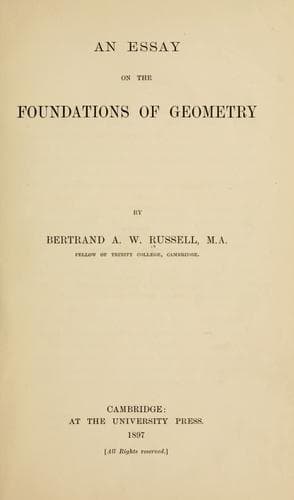
An essay on the foundations of geometryRussell, Bertrand
Philosophy
An essay on the foundations of geometry
Russell, Bertrand
Geometry -- Foundations
=160.= Let us, since the point seems of some interest, repeat our
proof of the apriority of this axiom from a slightly different point
of view. We will begin, this time, from the most abstract conception
of space, such as we find in Riemann's dissertation, or in Erdmann's
extents. We have here, an ordered manifold, infinitely divisible and
allowing of Free Mobility[168]. Free Mobility involves, as we saw,
the power of passing continuously from any one point to any other, by
any course which may seem pleasant to us; it involves, also, that,
in such a course, no changes occur except changes of mere position,
_i.e._, positions do not differ from one another in any qualitative
way. (This absence of qualitative difference is the distinguishing
mark of space as opposed to other manifolds, such as the colour- and
tone-systems: in these, every element has a definite qualitative
sensational value, whereas in space, the sensational value of a
position depends wholly on its spatial relation to our own body, and
is thus not intrinsic, but relative.) From the absence of qualitative
differences among positions, it follows logically that positions
exist only by virtue of other positions; one position differs from
another just because they are two, not because of anything intrinsic
in either. Position is thus defined simply and solely by relation to
other positions. Any position, therefore, is completely defined when,
and only when, enough such relations have been given to enable us to
determine its relation to any new position, this new position being
defined by the same number of relations. Now, in order that such
definition may be at all possible, a finite number of relations must
suffice. But every such relation constitutes a dimension. Therefore,
if Geometry is to be possible, it is _à priori_ necessary that space
should have a finite integral number of dimensions.
=161.= The limitation of the dimensions to three is, as we have
seen, empirical; nevertheless, it is not liable to the inaccuracy
and uncertainty which usually belong to empirical knowledge. For
the alternatives which logic leaves to sense are discrete--if the
dimensions are not three, they must be two or four or some other
number--so that _small_ errors are out of the question[169]. Hence
the final certainty of the axiom of three dimensions, though in part
due to experience, is of quite a different order from that of (say)
the law of Gravitation. In the latter, a small inaccuracy might exist
and remain undetected; in the former, an error would have to be so
considerable as to be utterly impossible to overlook. It follows that
the certainty of our whole axiom, that the number of dimensions is
three, is almost as great as that of the _à priori_ element, since
this element leaves to sense a definite disjunction of discrete
possibilities.
III. _The Axiom of Distance._
Public-domain text, read in full here on John Shaqi.
Reviews
Reviews
No reviews yet
Be the first to share your thoughts on this work.
Elsewhere in the archive
Join the Discussion
Join the discussion
Sign in to leave a comment or review.
Sign InorCreate an account