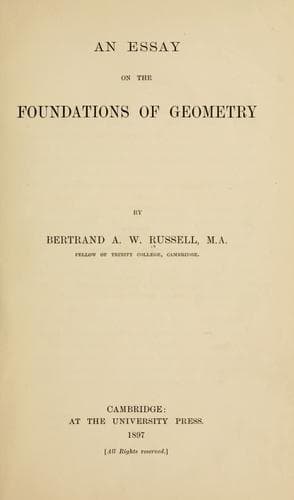
An essay on the foundations of geometryRussell, Bertrand
Philosophy
An essay on the foundations of geometry
Russell, Bertrand
Geometry -- Foundations
=170.= It will be remembered that, in our _à priori_ proof that
two points must have one definite relation, we held it impossible
for those two points to have, to the rest of space, any relation
which would be unaltered by motion. Now in spherical space, in the
particular case where the two points are antipodes, they _have_ a
relation, unaltered by motion, to the rest of space--the relation,
namely, that their distance is half the circumference of the
universe. In our former discussion, we assumed that any relation
to outside space must be a relation of position--and a relation of
position must be altered by motion. But with a finite space, in
which we have absolute magnitude, another relation becomes possible,
namely, a relation of magnitude. Antipodal points, accordingly,
like coincident points, no longer determine a unique straight line.
And it is instructive to observe that there is, in consequence, an
ambiguity in the expression for distance, like the ordinary ambiguity
in angular measurement. If 1/k^{2} be the space constant, and _d_
be one value for the distance between two points, 2πkn ± d, where
_n_ is any integer, is an equally good value. Distance is, in short,
a periodic function like angle. Thus such a state of things rather
confirms than destroys my contention, that distance depends on a
curve uniquely determined by two points. For as soon as we drop this
unique determination, we see ambiguities creeping into our expression
for distance. Distance still has a set of _discrete_ values,
corresponding to the fact that, given one point, the straight line
is uniquely determined for all other points but one, the antipodal
point. It is tempting to go on, and say: If through _every_ pair of
points there were an infinite number of the curves used in measuring
distance, distance would be able, for the same pair of points, to
take, not only a discrete series, but an infinite _continuous_ series
of values.
=171.= This, however, is mere speculation. I come now to the _pièce
de résistance_ of my argument. The ambiguity in spherical space
arose, as we saw, from a relation of _magnitude_ to the rest of
space--such a relation being unaltered by a motion of the two points,
and therefore falling outside our introductory reasoning. But what
is this relation of magnitude? Simply a relation of the _distance_
between the two points to a _distance_ given in the nature of the
space in question. It follows that such a relation _presupposes_ a
measure of distance, and need not, therefore, be contemplated in
any argument which deals with the _à priori_ requisites for the
possibility of definite distances[174].
Public-domain text, read in full here on John Shaqi.
Reviews
Reviews
No reviews yet
Be the first to share your thoughts on this work.
Elsewhere in the archive
Join the Discussion
Join the discussion
Sign in to leave a comment or review.
Sign InorCreate an account