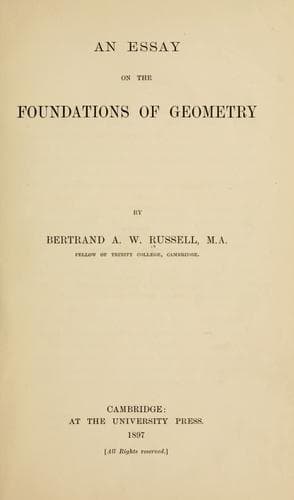
An essay on the foundations of geometryRussell, Bertrand
Philosophy
An essay on the foundations of geometry
Russell, Bertrand
Geometry -- Foundations
how are we to know that all the circles have equal radii, until we
have an independent measure of distance?
=168.= A straight line, then, is not the _shortest_ distance, but is
simply _the_ distance between two points--so far, this conclusion
has stood firm. But suppose we had two or more curves through
two points, and that all these curves were congruent _inter se_.
We should then say, in accordance with the definition of spatial
equality, that the lengths of all these curves were equal. Now
it might happen that, although no one of the curves was uniquely
determined by the two end-points, yet the common length of all the
curves was so determined. In this case, what would hinder us from
calling this common length the distance apart, although no unique
figure in space corresponded to it? This is the case contemplated by
spherical Geometry, where, as on a sphere, antipodes can be joined by
an infinite number of geodesics, all of which are of equal length.
The difficulty supposed is, therefore, not a purely imaginary one,
but one which modern Geometry forces us to face. I shall consequently
discuss it at some length.
=169.= To begin with, I must point out that my axiom is not quite
equivalent to Euclid's. Euclid's axiom states that two straight lines
cannot enclose a space, _i.e._, cannot have more than one common
point. Now if every two points, without exception, determine a unique
straight line, it follows, of course, that two different straight
lines can have only one point in common--so far, the two axioms are
equivalent. But it may happen, as in spherical space, that two points
_in general_ determine a unique straight line, but fail to do so
when they have to each other the special relation of being antipodes.
In such a system every pair of straight lines in the same plane meet
in two points, which are each other's antipodes; but two points, _in
general_, still determine a unique straight line. We are still able,
therefore, to obtain distances from unique straight lines, except in
limiting cases; and in such cases, we can take any point intermediate
between the two antipodes, join it by the _same_ straight line to
both antipodes, and measure its distance from those antipodes in the
usual way. The sum of these distances then gives a unique value for
the distance between the antipodes.
Thus even in spherical space, we are greatly assisted by the axiom
of the straight line; all linear measurement is effected by it, and
exceptional cases can be treated, through its help, by the usual
methods for limits. Spherical space, therefore, is not so adverse
as it at first appeared to be to the _à priori_ necessity of the
axiom. Nevertheless we have, so far, not attacked the kernel of the
objection which spherical space suggested. To this attack it is now
our duty to proceed.
Public-domain text, read in full here on John Shaqi.
Reviews
Reviews
No reviews yet
Be the first to share your thoughts on this work.
Elsewhere in the archive
Join the Discussion
Join the discussion
Sign in to leave a comment or review.
Sign InorCreate an account