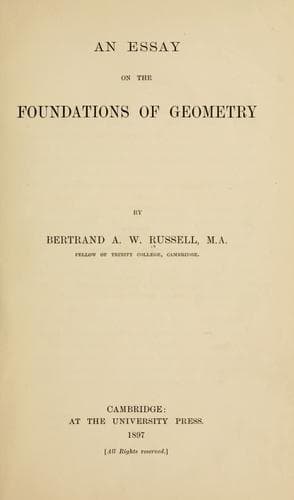
An essay on the foundations of geometryRussell, Bertrand
Philosophy
An essay on the foundations of geometry
Russell, Bertrand
Geometry -- Foundations
=173.= (3) But farther, the existence of curves uniquely determined
by two points can be deduced from the nature of any form of
externality[176]. For we saw, in discussing Free Mobility, that this
axiom, together with homogeneity and the relativity of position,
can be so deduced, and we saw in the beginning of our discussion on
distance, that the existence of a unique relation between two points
could be deduced from the homogeneity of space. Since position is
relative, we may say, any two points must have _some_ relation to
each other: since our form of externality is homogeneous, this
relation can be kept unchanged while the two points move in the
form, _i.e._, change their relations to other points; hence their
relation to each other is an intrinsic relation, independent of their
relations to other points. But since our form _is_ merely a complex
of relations, a relation of externality must appear in the form, with
the same evidence as anything else in the form; thus if the form be
intuitive or sensational, the relation must be immediately presented,
and not a mere inference. Hence the intrinsic relation between two
points must be a unique figure in our form, _i.e._ in spatial terms,
the straight line joining the two points.
=174.= (4) Finally, we have to prove that the existence of such a
curve necessarily leads, when quantity is applied to the relation
between two points, to a unique magnitude, which those two points
completely determine. With this, we shall be brought back to
distance, from which we started, and shall complete the circle of our
argument.
We saw, in section A § 119, that the figure formed by two points is
projectively indistinguishable from that formed by any two other
points in the same straight line; the figure, in both cases, is,
from the projective standpoint, simply the straight line on which
the two points lie. The difference of relation, in the two cases,
is not qualitative, since projective Geometry cannot deal with it;
nevertheless, there is some difference of relation. For instance, if
one point be kept fixed, while the other moves, there is obviously
some change of relation. This change, since all parts of the straight
line are qualitatively alike, must be a change of quantity. If two
points, therefore, determine a unique figure, there must exist, for
the distinction between the various other points of this figure, a
unique quantitative relation between the two determining points, and
therefore, since these points are arbitrary, between only two points.
This relation is _distance_, with which our argument began, and to
which it at least returns.
Public-domain text, read in full here on John Shaqi.
Reviews
Reviews
No reviews yet
Be the first to share your thoughts on this work.
Elsewhere in the archive
Join the Discussion
Join the discussion
Sign in to leave a comment or review.
Sign InorCreate an account