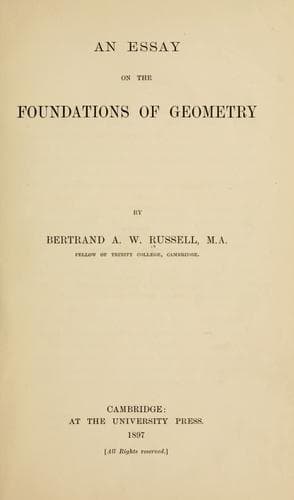
An essay on the foundations of geometryRussell, Bertrand
Philosophy
An essay on the foundations of geometry
Russell, Bertrand
Geometry -- Foundations
=175.= To sum up: If points are defined simply by relations to other
points, _i.e._, if all position is relative, _every point must have
to every other point one, and only one, relation independent of
the rest of space. This relation is the distance between the two
points._ Now a relation between two points can only be defined by a
line joining them--nay further, it may be contended that a relation
can only _be_ a line joining them. Hence a unique relation involves
a unique line, _i.e._, a line determined by any two of its points.
Only in a space which admits of such a line is linear magnitude a
logically possible conception. But when once we have established the
possibility, _in general_, of drawing such lines, and therefore of
measuring linear magnitudes, we may find that a certain magnitude has
a peculiar relation to the constitution of space. The straight line
may turn out to be of finite length, and in this case its length will
give a certain peculiar magnitude, the space-constant. Two antipodal
points, that is, points which bisect the entire straight line, will
then have a relation of magnitude which, though unaltered by motion,
is rendered peculiar by a certain constant relation to the rest of
space. This peculiarity presupposes a measure of linear magnitude in
general, and cannot, therefore, upset the apriority of the axiom of
the straight line. But it destroys, for points having the peculiar
antipodal relation to each other, the argument which proved that the
relation between two points could not, since it was unchanged by
motion, have reference to the rest of space. Thus it is intelligible
that, for such special points, the axiom breaks down, and an infinite
number of straight lines are possible between them; but unless we had
started with assuming the general validity of the axiom, we could
never have reached a position in which antipodal points could have
been known to be peculiar, or, indeed, a position which would have
enabled us to give any quantitative definition whatever of particular
points.
Distance and the straight line, as relations uniquely determined
by two points, are thus _à priori_ necessary to metrical Geometry.
But further, they are properties which must belong to any form of
externality. Since their necessity for Geometry was deduced from
homogeneity and the relativity of position, and since these are
necessary properties of any form of externality, the same argument
proves both conclusions. We thus obtain, as in the case of Free
Mobility, a double apriority: The axiom of Distance, and its
implication, the axiom of the Straight Line, are, on the one hand,
presupposed in the possibility of spatial magnitude, and cannot,
therefore, be contradicted by any experience resulting from the
measurement of space; while they are consequences, on the other hand,
of the necessary properties of any form of externality which is to
render possible experience of an external world.
Public-domain text, read in full here on John Shaqi.
Reviews
Reviews
No reviews yet
Be the first to share your thoughts on this work.
Elsewhere in the archive
Join the Discussion
Join the discussion
Sign in to leave a comment or review.
Sign InorCreate an account