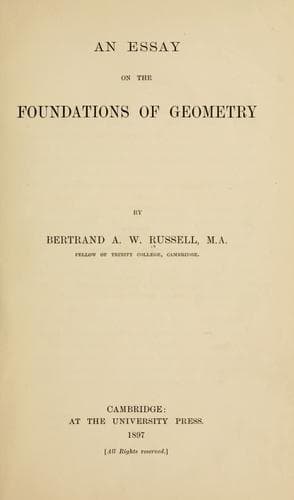
An essay on the foundations of geometryRussell, Bertrand
Philosophy
An essay on the foundations of geometry
Russell, Bertrand
Geometry -- Foundations
=184.= We have a right, therefore, in an epistemological inquiry, to
neglect Kant's psychological teaching--in so far, at any rate, as it
distinguishes spatial intuition from sensation--and attend rather to
the logical aspect alone. That part of his psychological teaching,
which maintains that space is not a mere conception, is, with certain
limitations, sufficiently evident as applied to actual space; but for
us, it must be transformed into a much more difficult thesis, namely,
that _no_ form of externality, which renders experience of diversity
in relation possible, can be merely conceptual. This question, to
which we must return later, is no longer psychological, but belongs
wholly to Epistemology.
=185.= What, then, remains the kernel, for our purposes, of Kant's
first argument for the apriority of space? His argument, in the form
in which he gave it, is concerned with the eccentric projection
of sensations. In order that I may refer sensations, he says,
to something outside myself, I must already have the subjective
space-form in the mind. In this shape, as Vaihinger points out
(Commentar, II. pp. 69, 165), the argument rests on a _petitio
principii_, for only if sensations are necessarily non-spatial does
their projection demand a subjective space-form. But, further, is the
logical apriority of space concerned with the externality of things
to ourselves?
Space _seems_ to perform two functions: on the one hand, it reveals
things, by the eccentric projection of sensations, as external
to the self, while, on the other hand, it reveals simultaneously
presented things as mutually external. These two functions, though
often treated as coordinate and almost equivalent[185], seem to me
widely different. Before we discuss the apriority of space, we must
carefully distinguish, I think, between these two functions, and
decide which of them we are to argue about.
Now externality to the Self, it would seem, must necessarily raise
the whole question of the nature and limits of the Ego, and what is
more, it cannot be derived from spatial presentation, unless we give
the Self a definite position in space. But things acquire a position
in space only when they can appear in sense-perception; we are
forced, therefore, if we adopt this view of the function of space, to
regard the Self as a phenomenon presented to sense-perception. But
this reduces externality to the Self to externality to the body. The
body, however, is a presented object like any other, and externality
of objects to it is, therefore, a special case of the mutual
externality of presented things. Hence we cannot regard space as
giving, primarily at any rate, externality to the Self, but only the
mutual externality of the things presented to sense-perception[186].
Public-domain text, read in full here on John Shaqi.
Reviews
Reviews
No reviews yet
Be the first to share your thoughts on this work.
Elsewhere in the archive
Join the Discussion
Join the discussion
Sign in to leave a comment or review.
Sign InorCreate an account