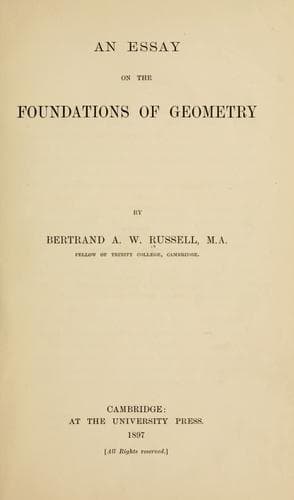
An essay on the foundations of geometryRussell, Bertrand
Philosophy
An essay on the foundations of geometry
Russell, Bertrand
Geometry -- Foundations
=183.= In the first place, the psychological element is much larger
in Kant's thesis than in mine. I shall contend, it is true, that a
form of externality, if it is to do its work, must not be a mere
conception or a mere inference, but must be a given element in
sense-perception--not, of course, originally given in isolation,
but discoverable, through analysis, by attention to the object of
sense-perception[179]. But Kant contended, not only that this element
is given, but also that it is subjective. Space, for him, is, on the
one hand, not conceptual, but on the other hand, not sensational.
It forms, for him, no part of the data of sense, but is added by a
subjective intuition, which he regards as not only logically, but
psychologically, prior to objects in space[180].
This part of Kant's argument is wholly irrelevant for us. Whether a
form of externality be given in sense, or in a pure intuition, is for
us unimportant, since we neglect the question as to the connection
of the _à priori_ and the subjective; while the temporal priority of
space to objects in it has been generally recognized as irrelevant
to Epistemology, and has often been regarded as forming no part of
Kant's thesis[181]. If we call intuitional whatever is given in
sense-perception, then we may contend that a form of externality must
be intuitional; but whether it is a pure intuition, in Kant's sense,
or not, is irrelevant to us, as is its priority to the objects in it.
That the non-sensational nature of space is no essential part of
Kant's _logical_ teaching, appears from an examination of his
argument. He has made, in the introduction, the purely logical
distinction of matter and form, but has given to this distinction,
in the very moment of suggesting it, a psychological implication.
This he does by the assertion that the form, in which the matter
of sensations is ordered, cannot itself be sensational. From this
assumption it follows, of course, that space cannot be sensational.
But the assumption is totally unsupported by argument, being set
forth, apparently, as a self-evident axiom; it has been severely
criticized by Stumpf[182] and others[183], and has been described by
Vaihinger as a fatal _petitio principii_[184]; it is irrelevant to
the logical argument, when this argument is separated, as we have
separated it, from all connection with psychological subjectivity;
and finally, it leaves us a prey to psychological theories of space,
which have seemed, of late, but little favourable to the pure Kantian
doctrine.
Public-domain text, read in full here on John Shaqi.
Reviews
Reviews
No reviews yet
Be the first to share your thoughts on this work.
Elsewhere in the archive
Join the Discussion
Join the discussion
Sign in to leave a comment or review.
Sign InorCreate an account