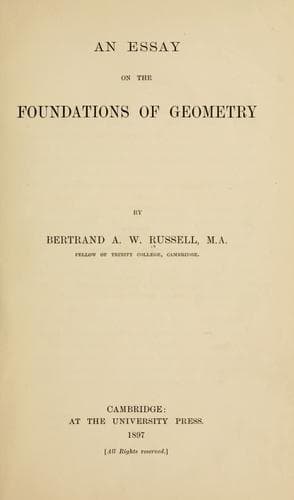
An essay on the foundations of geometryRussell, Bertrand
Philosophy
An essay on the foundations of geometry
Russell, Bertrand
Geometry -- Foundations
=188.= This doctrine of Bradley and Bosanquet is the converse of
the epistemological doctrine I have to advocate. Owing to the
continuity and relativity of space and time, they say, we are able
to construct a systematic world, by judgment and inference, out of
that fragmentary and yet necessarily complex existence which is
given in sense-perception. My contention is, conversely, that since
all knowledge is necessarily derived by an extension of the _This_
of sense-perception, and since such extension is only possible if
the _This_ has that fragmentary and yet complex character conferred
by a form of externality, therefore some form of externality,
given with the _This_, is essential to all knowledge, and is thus
logically _à priori_. Bradley's argument, if sound, already proves
this contention; for while, on the one hand, he uses no properties of
space and time but those which belong to every form of externality,
he proves, on the other hand, that judgment and inference require
the _This_ to be neither single nor self-subsistent. But I will
endeavour, since the point is of fundamental importance, to
reproduce the proof, in a form more suited than Bradley's to the
epistemological question.
=189.= The essence of my contention is that, if experience is to be
possible, every sensational _This_ must, when attended to, be found,
on the one hand, resolvable into _Thises_, and on the other hand
dependent, for some of its adjectives, on external reference. The
second of these theses follows from the first, for if we take one
of the _Thises_ contained in the first _This_, we get a new _This_
necessarily related to the other _Thises_ which make up the original
_This_. I may, therefore, confine myself to the first proposition,
which affirms that the object of perception must contain a diversity,
not only of conceptual content, but of existence, and that this can
only be known if sense-perception contains, as an element, some form
of externality.
My premiss, in this argument, is that all knowledge involves a
recognition of diversity in relation, or, if we prefer it, of
identity in difference. This premiss I accept from Logic, as
resulting from the analysis of judgment and inference. To prove
such a premiss, would require a treatise on Logic; I must refer the
reader, therefore, to the works of Bradley and Bosanquet on the
subject. It follows at once, from my premiss, that knowledge would be
impossible, unless the object of attention could be complex, _i.e._
not a _mere_ particular. Now could the mental object--_i.e._, in this
connection, the object of a cognition--be complex, if the object of
immediate perception were always simple?
Public-domain text, read in full here on John Shaqi.
Reviews
Reviews
No reviews yet
Be the first to share your thoughts on this work.
Elsewhere in the archive
Join the Discussion
Join the discussion
Sign in to leave a comment or review.
Sign InorCreate an account