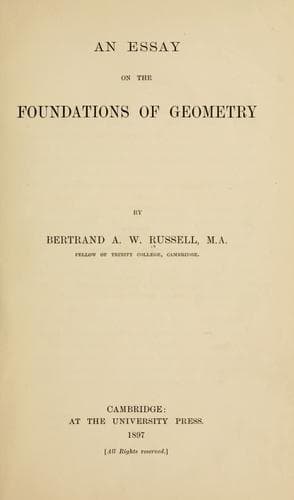
An essay on the foundations of geometryRussell, Bertrand
Philosophy
An essay on the foundations of geometry
Russell, Bertrand
Geometry -- Foundations
=190.= We might be inclined, at first sight, to answer this question
affirmatively. But several difficulties, I think, would prevent
such an answer. In the first place, knowledge must start from
perception. Hence, either we could have no knowledge except of our
present perception, or else we must be able to contrast and compare
it with some other perception. Now in the first case, since the
present perception, by hypothesis, is a mere particular, knowledge
of it is impossible, according to our premiss. But in the second
case, the other perception, with which we compare our first, must
have occurred at some other time, and with time, we have at once a
form of externality. But what is more, our present perception is
no longer a mere particular. For the power of comparing it with
another perception involves a point of identity between the two, and
thus renders both complex. Moreover, time must be continuous, and
the present, as Bradley points out, is no mere point of time[188].
Thus our present perception contains the complexity involved in
duration throughout the specious present: its mere particularity
and its simplicity are lost. Its self-subsistence is also lost, for
beyond the specious present, lie the past and the future, to which
our present perception thus unavoidably refers us. Time at least,
therefore, is essential to that identity in difference, which all
knowledge postulates.
=191.= But we have derived, from all this, no ground for affirming a
multiplicity of real things, or a form of externality of more than
one dimension, which, we saw, was necessary for the truth of two out
of our three axioms. This brings us to the question: Have we enough,
with time alone as a form of externality, for the possibility of
knowledge?
This question we must, I think, answer in the negative. With time
alone, we have seen, our presented object must be complex, but its
complexity must, if I may use such a phrase, be merely adjectival.
Without a second form of externality, only one thing can be given at
one moment[189], and this one thing, therefore, must constitute the
whole of our world. The object of past perception must--since our one
thing has nothing external to it, by which it could be created or
destroyed--be regarded as the same thing in a different state. The
complexity, therefore, will lie only in the changing states of our
one thing--it will be adjectival, not substantival. Moreover we have
the following dilemma: Either the one thing must be ourselves, or
else self-consciousness could never arise. But the chief difficulty
of such a world would lie in the changes of the thing. What could
cause these changes, since we should know of nothing external to our
thing? It would be like a Leibnitzian monad, without any God outside
it to prearrange its changes. Causality, in such a world, could not
be applied, and change would be wholly inexplicable.
Public-domain text, read in full here on John Shaqi.
Reviews
Reviews
No reviews yet
Be the first to share your thoughts on this work.
Elsewhere in the archive
Join the Discussion
Join the discussion
Sign in to leave a comment or review.
Sign InorCreate an account