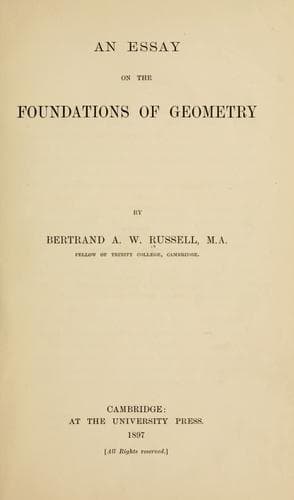
An essay on the foundations of geometryRussell, Bertrand
Philosophy
An essay on the foundations of geometry
Russell, Bertrand
Geometry -- Foundations
Hence we require also the possibility of a diversity of
simultaneously existing things, not merely of successive adjectives;
and this, we have seen, cannot be given by time alone, but only by
a form of externality for simultaneous parts of one presentation.
We could never, in other words, infer the existence of diverse but
interrelated things, unless the object of sense-perception could have
substantival complexity, and for such complexity we require a form
of externality other than time. Such a form, moreover, as was shown
in Chapter III., Section A (§ 135), can only fulfil its functions
if it has more than one dimension. In our actual world, this form
is given by space; in any world, knowable to beings with our laws
of thought, some such form, as we have now seen, must be given in
sense-perception.
This argument may be briefly summed up, by assuming the doctrine
of Bradley, that all knowledge is obtained by inference from the
_This_ of sense-perception. For, if this be so, the _This_--in
order that inference, which depends on identity in difference, may
be possible at all--must itself be complex, and must, on analysis,
reveal adjectives having a reference beyond itself. But this, as was
shown above, can only happen by means of a form of externality. This
establishes the à priori axioms of Geometry, as necessarily having
existential import and validity in any intelligible world.
=192.= The above argument, I hope, has explained why I hold it
possible to deduce, from a mere conception like that of a form
of externality, the logical apriority of certain axioms as to
experienced space. The Kantian argument--which was correct, if our
reasoning has been sound, in asserting that real diversity, in our
actual world, could only be known by the help of space--was only
mistaken, so far as its purely logical scope extends, in overlooking
the possibility of other forms of externality, which could, if they
existed, perform the same task with equal efficiency. In so far as
space differs, therefore, from these other conceptions of possible
intuitional forms, it is a mere experienced fact, while in so far as
its properties are those which all such forms must have, it is _à
priori_ necessary to the possibility of experience.
Public-domain text, read in full here on John Shaqi.
Reviews
Reviews
No reviews yet
Be the first to share your thoughts on this work.
Elsewhere in the archive
Join the Discussion
Join the discussion
Sign in to leave a comment or review.
Sign InorCreate an account