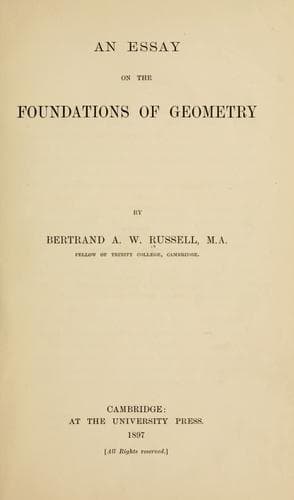
An essay on the foundations of geometryRussell, Bertrand
Philosophy
An essay on the foundations of geometry
Russell, Bertrand
Geometry -- Foundations
=194.= I come now to the second question with which this chapter
has to deal, the question, namely: What are we to do with the
contradictions which obtruded themselves in Chapter III., whenever we
came to a point which seemed fundamental? I shall treat this question
briefly, as I have little to add to answers with which we are all
familiar. I have only to prove, first, that the contradictions are
inevitable, and therefore form no objection to my argument; secondly,
that the first step in removing them is to restore the notion of
matter, as that which, in the data of sense-perception, is localized
and interrelated in space.
=195.= The contradictions in space are an ancient theme--as ancient,
in fact, as Zeno's refutation of motion. They are, roughly, of two
kinds, though the two kinds cannot be sharply divided. There are
the contradictions inherent in the notion of the continuum, and the
contradictions which spring from the fact that space, while it must,
to be knowable, be pure relativity, must also, it would seem, since
it is immediately experienced, be something more than mere relations.
The first class of contradictions has been encountered more
frequently in this essay, and is also, I think, the more definite,
and the more important for our present purpose. I doubt, however,
whether the two classes are really distinct; for any continuum,
I believe, in which the elements are not data, but intellectual
constructions resulting from analysis, can be shown to have the same
relational and yet not wholly relational character as belongs to
space.
The three following contradictions, which I shall discuss
successively, seem to me the most prominent in a theory of Geometry.
(1) Though the parts of space are intuitively distinguished, no
conception is adequate to differentiate them. Hence arises a
vain search for elements, by which the differentiation could be
accomplished, and for a whole, of which the parts of space are to be
components. Thus we get the point, or zero extension, as the spatial
element, and an infinite regress or a vicious circle in the search
for a whole.
(2) All positions being relative, positions can only be defined by
their relations, _i.e._ by the straight lines or planes through
them; but straight lines and planes, being all qualitatively similar,
can only be defined by the positions they relate. Hence, again, we
get a vicious circle.
(3) Spatial figures must be regarded as relations. But a relation
is necessarily indivisible, while spatial figures are necessarily
divisible _ad infinitum_.
Public-domain text, read in full here on John Shaqi.
Reviews
Reviews
No reviews yet
Be the first to share your thoughts on this work.
Elsewhere in the archive
Join the Discussion
Join the discussion
Sign in to leave a comment or review.
Sign InorCreate an account