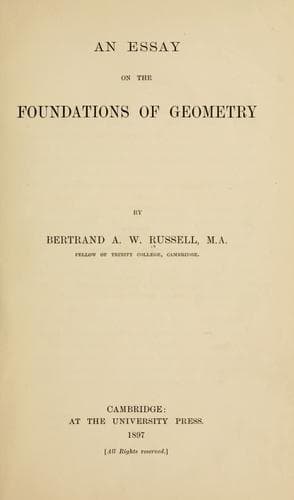
An essay on the foundations of geometryRussell, Bertrand
Philosophy
An essay on the foundations of geometry
Russell, Bertrand
Geometry -- Foundations
=196.= (1) _Points._ The antinomy of the point--which arises wherever
a continuum is given, and elements have to be sought in it--is
fundamental to Geometry. It has been given, perhaps unintentionally,
by Veronese as the first axiom, in the form: "There are different
points. All points are identical" (_op. cit._ p. 226). We saw, in
discussing projective Geometry, that straight lines and planes must
be regarded, on the one hand as relations between points, and on the
other hand as made up of points[190]. We saw again, in dealing with
measurement, how space must be regarded as infinitely divisible,
and yet as mere relativity. But what is divisible and consists of
parts, as space does, must lead at last, by continued analysis, to
a simple and unanalyzable part, as the unit of differentiation. For
whatever can be divided, and has parts, possesses some thinghood,
and must, therefore, contain two ultimate units, the whole namely,
and the smallest element possessing thinghood. But in space this is
notoriously not the case. After hypostatizing space, as Geometry
is compelled to do, the mind imperatively demands elements, and
insists on having them, whether possible or not. Of this demand,
all the geometrical applications of the infinitesimal calculus are
evidence[191]. But what sort of elements do we thus obtain? Analysis,
being unable to find any earlier halting-place, finds its elements
in points, that is, in zero quanta of space. Such a conception is
a palpable contradiction, only rendered tolerable by its necessity
and familiarity. A point must be spatial, otherwise it would not
fulfil the function of a spatial element; but again it must contain
no space, for any finite extension is capable of further analysis.
Points can never be given in intuition, which has no concern with the
infinitesimal: they are a purely conceptual construction, arising
out of the need of terms between which spatial relations can hold.
If space be more than relativity, spatial relations must involve
spatial relata; but no relata appear, until we have analyzed our
spatial data down to nothing. The contradictory notion of the point,
as a thing in space without spatial magnitude, is the only outcome
of our search for spatial relata. This _reductio ad absurdum_ surely
suffices, by itself, to prove the essential relativity of space.
Public-domain text, read in full here on John Shaqi.
Reviews
Reviews
No reviews yet
Be the first to share your thoughts on this work.
Elsewhere in the archive
Join the Discussion
Join the discussion
Sign in to leave a comment or review.
Sign InorCreate an account