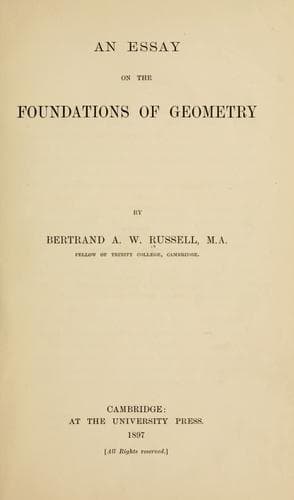
An essay on the foundations of geometryRussell, Bertrand
Philosophy
An essay on the foundations of geometry
Russell, Bertrand
Geometry -- Foundations
=201.= (3) _Space is at once relational and more than relational._
We have already touched on the question how far space is other than
relations, but as this question is quite fundamental, as _relation_
is an ambiguous and dangerous word, as I have made constant use of
the relativity of space without attempting to define a relation, it
will be necessary to discuss this antinomy at length.
=202.= Now for this discussion it is essential to distinguish clearly
between empty space and spatial figures. Empty space, as a form
of externality, is not actual relations, but the possibility of
relations: if we ascribe existential import to it, as the ground,
in reality, of all diversity in relation, we at once have space as
something not itself relations, though giving the possibility of all
relations. In this sense, space is to be distinguished from spatial
order. Spatial order, it may be said, presupposes space, as that in
which this order is possible. Thus Stumpf says[195]: "There is no
order or relation without a positive absolute content, underlying
it, and making it possible to order anything in this manner. Why and
how should we otherwise distinguish one order from another?... To
distinguish different orders from one another, we must everywhere
recognize a particular absolute content, in relation to which the
order takes place. And so space, too, is not a mere order, but just
that by which the spatial order, side-by-sideness (_Nebeneinander_)
distinguishes itself from the rest."
May we not, then, resolve the antinomy very simply, by a reference to
this ambiguity of space? Bradley contends (Appearance and Reality,
pp. 36-7) that, on the one hand, space has parts, and is therefore
not mere relations, while on the other hand, when we try to say what
these parts are, we find them after all to be mere relations. But
cannot the space which has parts be regarded as empty space, Stumpf's
absolute underlying content, which is not mere relations, while the
parts, in so far as they turn out to be mere relations, are those
relations which constitute spatial order, not empty space? If this
can be maintained, the antinomy no longer exists.
But such an explanation, though I believe it to be a first step
towards a solution, will, I fear, itself demand almost as much
explanation as the original difficulty. For the connection of empty
space with spatial order is itself a question full of difficulty, to
be answered only after much labour.
Public-domain text, read in full here on John Shaqi.
Reviews
Reviews
No reviews yet
Be the first to share your thoughts on this work.
Elsewhere in the archive
Join the Discussion
Join the discussion
Sign in to leave a comment or review.
Sign InorCreate an account