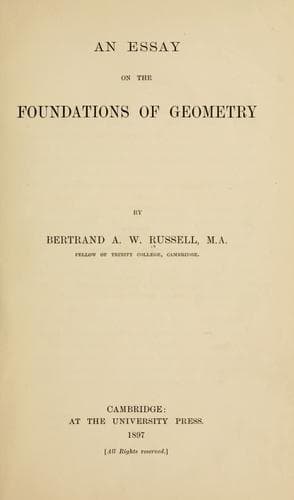
An essay on the foundations of geometryRussell, Bertrand
Philosophy
An essay on the foundations of geometry
Russell, Bertrand
Geometry -- Foundations
Empty space, we have said, is a possibility of diversity in
relation, but spatial figures, with which Geometry necessarily
deals, are the actual relations rendered possible by empty space.
Our matter, therefore, must supply the terms for these relations.
It must be differentiated, since such differentiation, as we have
seen, is the special work of space. We must find, therefore, in
our matter, that unit of differentiation, or atom[194], which in
space we could not find. This atom must be simple, _i.e._ it must
contain no real diversity; it must be a _This_ not resolvable into
_Thises_. Being simple, it can contain no relations within itself,
and consequently, since spatial figures are mere relations, it cannot
appear as a spatial figure; for every spatial figure involves some
diversity of matter. But our atom must have spatial relations with
other atoms, since to supply terms for these relations is its only
function. It is also capable of having these relations, since it is
differentiated from other atoms. Hence we obtain an unextended term
for spatial relations, precisely of the kind we require. So long as
we sought this term without reference to anything more than space,
the self-contradictory notion of the point was the only outcome
of our search; but now that we allow a reference to the matter
differentiated by space, we find at once the term which was needed,
namely, a non-spatial simple element, with spatial relations to other
elements. To Geometry such a term will appear, owing to its spatial
relations, as a point; but the contradiction of the point, as we now
see, is a result only of the undue abstraction with which Geometry
deals.
=200.= (2) _The circle in the definition of straight lines and
planes._ This difficulty need not long detain us, since we have
already, with the material atom, broken through the relativity
which caused our circle. Straight lines, in the purely geometrical
procedure, are defined only by points, and points only by straight
lines. But points, now, are replaced by material atoms: the duality
of points and lines, therefore, has disappeared, and the straight
line may be defined as the spatial relation between two unextended
atoms. These atoms have spatial adjectives, derived from their
relations to other atoms; but they have no _intrinsic_ spatial
adjectives, such as could belong to them if they had extension or
figure. Thus straight lines and planes are the true spatial units,
and points result only from the attempt to find, within space, those
terms for spatial relations which exist only in a more than spatial
matter. Straight lines, planes and volumes are the spatial relations
between two, three or four unextended atoms, and points are a merely
convenient geometrical fiction, by which possible atoms are replaced.
For, since space, as we saw, is a possibility, Geometry deals not
with actually realized spatial relations, but with the whole scheme
of possible relations.
Public-domain text, read in full here on John Shaqi.
Reviews
Reviews
No reviews yet
Be the first to share your thoughts on this work.
Elsewhere in the archive
Join the Discussion
Join the discussion
Sign in to leave a comment or review.
Sign InorCreate an account