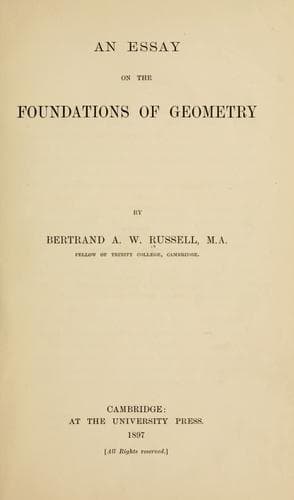
An essay on the foundations of geometryRussell, Bertrand
Philosophy
An essay on the foundations of geometry
Russell, Bertrand
Geometry -- Foundations
The same reference to matter, then, by which the antinomy of the
Point was solved, solves also the antinomy as to the relational
nature of space. Space, if it is to be freed from contradictions,
must be regarded exclusively as spatial order, as relations between
unextended material atoms. Empty space, which arises, by an
inevitable illusion, out of the spatial element in sense-perception,
may be regarded, if we wish to retain it, as the bare principle of
relativity, the bare logical possibility of relations between diverse
things. In this sense, empty space is wholly conceptual; spatial
order alone is immediately experienced.
=208.= But in what sense does spatial order consist of relations?
We have hitherto spoken of externality as a relation, and in a
sense such a manner of speaking is justified. Externality, when
predicated of anything, is an adjective of that thing, and implies
a reference to some other thing. To this extent, then, externality
is analogous to other relations; and only to this extent, in our
previous arguments, has it been regarded as a relation. But when we
take account of further qualities of relations, externality begins to
appear, not so much as a relation, but rather as a necessary aspect
or element in every relation. And this is borne out by the necessity,
for the existence of relations, of some given form of externality.
Every relation, we may say, involves a diversity between the
related terms, but also some unity. Mere diversity does not give
a ground for that interaction, and that interdependence, which a
relation requires. Mere unity leaves the terms identical, and thus
destroys the reference of one to another required for a relation.
Mere externality, taken in abstraction, gives only the element of
diversity required for a relation, and is thus more abstract than any
actual relation. But mere diversity does not give that indivisible
whole of which any actual relation must consist, and is thus, when
regarded abstractly, not subject to the restrictions of ordinary
relations.
But with mere diversity, we seem to have returned to empty space, and
abandoned spatial order. Mere diversity, surely, is either complete
or non-existent; degrees of diversity, or a quantitative measure of
it, are nonsense. We cannot, therefore, reduce spatial order to mere
diversity. Two things, if they occupy different positions in space,
are necessarily diverse, but are as necessarily something more;
otherwise spatial order becomes unmeaning.
Public-domain text, read in full here on John Shaqi.
Reviews
Reviews
No reviews yet
Be the first to share your thoughts on this work.
Elsewhere in the archive
Join the Discussion
Join the discussion
Sign in to leave a comment or review.
Sign InorCreate an account