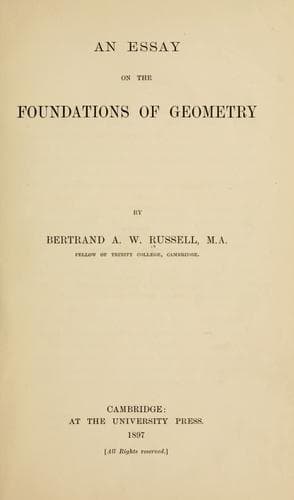
An essay on the foundations of geometryRussell, Bertrand
Philosophy
An essay on the foundations of geometry
Russell, Bertrand
Geometry -- Foundations
Empty space, then, in the above sense of the possibility of spatial
relations, contains only one aspect of a relation, namely the aspect
of diversity; but spatial order, by its reference to matter, becomes
more concrete, and contains also the element of unity, arising out
of the connection of the different material atoms. Spatial order,
then, consists of relations in the ordinary sense; its merely
spatial element, however--if one may make such a distinction--the
element, that is, which can be abstracted from matter and regarded
as constituting empty space, is only one aspect of a relation, but
an aspect which, in the concrete, must be inseparably bound up
with the other aspect. Here, once more, we see the ground of the
contradictions in empty space, and the reason why spatial order is
free from these contradictions.
_Conclusion._
=209.= We have now completed our review of the foundations of
Geometry. It will be well, before we take leave of the subject,
briefly to review and recapitulate the results we have won.
In the first chapter, we watched the development of a branch of
Mathematics designed, at first, only to establish the logical
independence of Euclid's axiom of parallels, and the possibility
of a self-consistent Geometry which dispensed with it. We found
the further development of the subject entangled, for a while, in
philosophical controversy; having shown one axiom to be superfluous,
the geometers of the second period hoped to prove the same conclusion
of all the others, but failed to construct any system free from three
fundamental axioms. Being concerned with analytical and metrical
Geometry, they tended to regard Algebra as _à priori_, but held that
those properties of spatial magnitudes, which were not deducible from
the laws of Algebra, must be empirical. In all this, they aimed as
much at discrediting Kant as at advancing Mathematics. But with the
third period, the interest in Philosophy diminishes, the opposition
to Euclid becomes less marked, and most important of all, measurement
is no longer regarded as fundamental, and space is dealt with by
descriptive rather than quantitative methods. But nevertheless,
three axioms, substantially the same as those retained in the second
period, are still retained by all geometers.
Public-domain text, read in full here on John Shaqi.
Reviews
Reviews
No reviews yet
Be the first to share your thoughts on this work.
Elsewhere in the archive
Join the Discussion
Join the discussion
Sign in to leave a comment or review.
Sign InorCreate an account