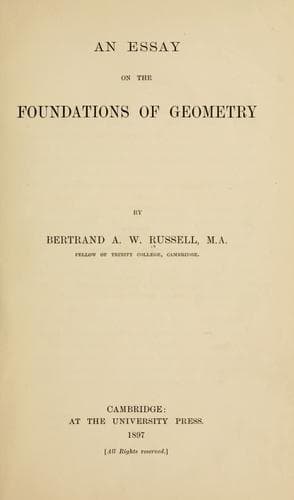
An essay on the foundations of geometryRussell, Bertrand
Philosophy
An essay on the foundations of geometry
Russell, Bertrand
Geometry -- Foundations
In the present chapter, we completed our proof of the apriority
of the projective and equivalent metrical axioms, by showing the
necessity, for experience, of some form of externality, given by
sensation or intuition, and not merely inferred from other data.
Without this, we said, a knowledge of diverse but interrelated
things, the corner-stone of all experience, would be impossible.
Finally, we discussed the contradictions arising out of the
relativity and continuity of space, and endeavoured to overcome
them by a reference to matter. This matter, we found, must consist
of unextended atoms, localized by their spatial relations, and
appearing, in Geometry, as points. But the non-spatial adjectives
of matter, we contended, are irrelevant to Geometry, and its
causal properties may be left out of account. To deal with the new
contradictions, involved in such a notion of matter, would demand
a fresh treatise, leading us, through Kinematics, into the domains
of Dynamics and Physics. But to discuss the special difficulties
of space is all that is possible in an essay on the Foundations of
Geometry.
FOOTNOTES:
[178] Compare, with the following paragraphs, the admirable
discussion in Mr Hobhouse's Theory of Knowledge (Methuen 1896), Part
I. Chapter II.
[179] I speak of sense-perception instead of sensation, so as not to
prejudge the issue as to the sensational nature of space.
[180] See Vaihinger's Commentar, II. pp. 86-7, 168-171.
[181] See Caird, Critical Philosophy of Kant, Vol. I. p. 287.
[182] Ursprung der Raumvorstellung, pp. 12-30.
[183] See the references in Vaihinger's Commentar, II. p. 76 ff.
[184] Commentar, II. p. 71 ff.
[185] _E.g._ by Caird, _op. cit._ Vol. I. p. 286.
[186] I have no wish to deny, however, that space is essential in the
subsequent distinction of Self and not-Self.
[187] See also Book I. Chap II. passim; especially p. 51 ff. and pp.
70-1.
[188] Logic, p. 51 ff.
[189] For the _This_, on such a hypothesis, has a purely temporal
complexity, and is not resolvable into coexisting _Thises_.
[190] Chapter III. Section A, (§ 131).
[191] Cf. Hannequin, Essai critique sur l'hypothèse des atomes, Paris
1895, Chap. I. Section III.; especially p. 43.
[192] See Chapter II. § 69 ff.
[193] See third antinomy below, § 201 ff.
[194] This atom, of course, must not be confounded with the atom of
Chemistry.
[195] Ursprung der Raumvorstellung, p. 15.
[196] See Vaihinger's Commentar, II. pp. 189-190.
[197] See ibid. p. 224 ff. for Kant's inconsistencies on this point.
[198] The fourth and fifth in the first edition, the third and fourth
in the second.
[199] Cf. Vaihinger's Commentar, II. p. 218.
[200] Cf. Vaihinger's Commentar, II. p. 207.
[201] Cf. James, Psychology, Vol. II., p. 148 ff.
Cambridge:
PRINTED BY J. AND C. F. CLAY,
AT THE UNIVERSITY PRESS.
TRANSCRIBER'S NOTE
Italic text is denoted by _underscores_.
Bold text is denoted by =equal signs=.
Public-domain text, read in full here on John Shaqi.
Reviews
Reviews
No reviews yet
Be the first to share your thoughts on this work.
Elsewhere in the archive
Join the Discussion
Join the discussion
Sign in to leave a comment or review.
Sign InorCreate an account