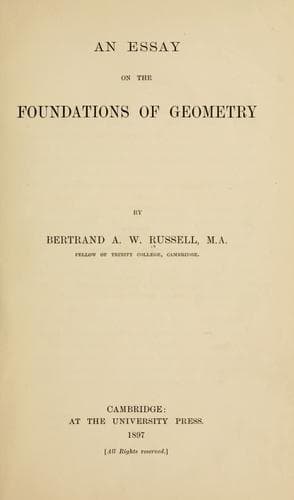
An essay on the foundations of geometryRussell, Bertrand
Philosophy
An essay on the foundations of geometry
Russell, Bertrand
Geometry -- Foundations
In the second chapter, we endeavoured, by a criticism of some
geometrical philosophies, to prepare the ground for a constructive
theory of Geometry. We saw that Kant, in applying the argument of
the Transcendental Aesthetic to space, had gone too far, since
its logical scope extended only to some form of externality in
general. We saw that Riemann, Helmholtz and Erdmann, misled by the
quantitative bias, overlooked the qualitative substratum required
by all judgments of quantity, and thus mistook the direction in
which the necessary axioms of Geometry are to be found. We rejected,
also, Helmholtz's view that Geometry depends on Physics, because we
found that Physics must assume a knowledge of Geometry before it
can become possible. But we admitted, in Geometry, a reference to
matter--not, however, to matter as empirically known in Physics, but
to a more abstract matter, whose sole function is to appear in space,
and supply the terms for spatial relations. We admitted, however,
besides this, that all _actual_ measurement must be effected by means
of _actual_ matter, and is only empirically possible, through the
empirical knowledge of approximately rigid bodies. In criticizing
Lotze, we saw that the most important sense, in which non-Euclidean
spaces are possible, is a philosophical sense, namely, that they are
not condemned by any _à priori_ argument as to the necessity of space
for experience, and that consequently, if they are not affirmed,
this must be on empirical grounds alone. Lotze's strictures on the
mathematical procedure of Metageometry we found to be wholly due to
ignorance of the subject.
Proceeding, in the third chapter, to a constructive theory of
Geometry, we saw that projective Geometry, which has no reference to
quantity, is necessarily true of any form of externality. Its three
axioms--homogeneity, dimensions, and the straight line--were all
deduced from the conception of a form of externality, and, since some
such form is necessary to experience, were all declared _à priori_.
In metrical Geometry, on the contrary, we found an empirical element,
arising out of the alternatives of Euclidean and non-Euclidean space.
Three _à priori_ axioms, common to these spaces, and necessary
conditions of the possibility of measurement, still remained; these
were the axiom of Free Mobility, the axiom that space has a finite
integral number of dimensions, and the axiom of distance. Except for
the new idea of motion, these were found equivalent to the projective
triad, and thus necessarily true of any form of externality. But
the remaining axioms of Euclid--the axiom of three dimensions, the
axiom that two straight lines can never enclose a space, and the
axiom of parallels--were regarded as empirical laws, derived from the
investigation and measurement of our actual space, and true only, as
far as the last two are concerned, within the limits set by errors of
observation.
Public-domain text, read in full here on John Shaqi.
Reviews
Reviews
No reviews yet
Be the first to share your thoughts on this work.
Elsewhere in the archive
Join the Discussion
Join the discussion
Sign in to leave a comment or review.
Sign InorCreate an account