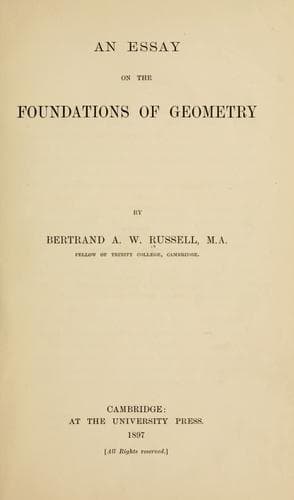
An essay on the foundations of geometryRussell, Bertrand
Philosophy
An essay on the foundations of geometry
Russell, Bertrand
Geometry -- Foundations
42. Has a merely technical validity, 42
43. And is capable of giving geometrical results only when it
begins and ends with real points and figures 45
44. We have now seen that projective Geometry is logically prior
to metrical Geometry, but cannot supersede it 46
45. Sophus Lie has applied projective methods to Helmholtz's
formulation of the axioms, and has shown the axiom of
Monodromy to be superfluous 46
46. Metageometry has gradually grown independent of philosophy,
but has grown continually more interesting to philosophy 50
47. Metrical Geometry has three indispensable axioms, 50
48. Which we shall find to be not results, but conditions, of
measurement, 51
49. And which are nearly equivalent to the three axioms of
projective Geometry 52
50. Both sets of axioms are necessitated, not by facts, but by
logic 52
CHAPTER II.
CRITICAL ACCOUNT OF SOME PREVIOUS PHILOSOPHICAL
THEORIES OF GEOMETRY.
51. A criticism of representative modern theories need not begin
before Kant 54
52. Kant's doctrine must be taken, in an argument about Geometry,
on its purely logical side 55
53. Kant contends that since Geometry is apodeictic, space must
be _à priori_ and subjective, while since space is _à priori_
and subjective, Geometry must be apodeictic 55
54. Metageometry has upset the first line of argument, not the
second 56
55. The second may be attacked by criticizing either the distinction
of synthetic and analytic judgments, or the first two arguments
of the metaphysical deduction of space 57
56. Modern Logic regards every judgment as both synthetic and
analytic, 57
57. But leaves the _à priori_, as that which is presupposed in the
possibility of experience 59
58. Kant's first two arguments as to space suffice to prove _some_
form of externality, but not necessarily Euclidean space, a
necessary condition of experience 60
59. Among the successors of Kant, Herbart alone advanced the
theory of Geometry, by influencing Riemann 62
60. Riemann regarded space as a particular kind of manifold, i.e.
wholly quantitatively 63
Public-domain text, read in full here on John Shaqi.
Reviews
Reviews
No reviews yet
Be the first to share your thoughts on this work.
Join the Discussion
Join the discussion
Sign in to leave a comment or review.
Sign InorCreate an account