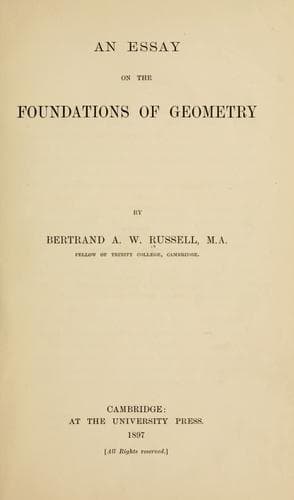
An essay on the foundations of geometryRussell, Bertrand
Philosophy
An essay on the foundations of geometry
Russell, Bertrand
Geometry -- Foundations
=51.= We have now traced the mathematical development of the theory
of geometrical axioms, from the first revolt against Euclid to the
present day. We may hope, therefore, to have at our command the
technical knowledge required for the philosophy of the subject. The
importance of Geometry, in the theories of knowledge which have
arisen in the past, can scarcely be exaggerated. In Descartes, we
find the whole theory of method dominated by analytical Geometry, of
whose fruitfulness he was justly proud. In Spinoza, the paramount
influence of Geometry is too obvious to require comment. Among
mathematicians, Newton's belief in absolute space was long supreme,
and is still responsible for the current formulation of the laws of
motion. Against this belief on the one hand, and against Leibnitz's
theory of space on the other, and not, as Caird has pointed out[67],
against Hume's empiricism, was directed that keystone of the Critical
Philosophy, the Kantian doctrine of space. Thus Geometry has been,
throughout, of supreme importance in the theory of knowledge.
But in a criticism of representative modern theories of Geometry,
which is designed to be, not a history of the subject, but an
introduction to, and defence of, the views of the author, it will
not be necessary to discuss any more ancient theory than that of
Kant. Kant's views on this subject, true or false, have so dominated
subsequent thought, that whether they were accepted or rejected,
they seemed equally potent in forming the opinions, and the manner of
exposition, of almost all later writers.
Kant.
=52.= It is not my purpose, in this chapter, to add to the voluminous
literature of Kantian criticism, but only to discuss the bearing of
Metageometry on the argument of the Transcendental Aesthetic, and
the aspect under which this argument must be viewed in a discussion
of Geometry[68]. On this point several misunderstandings seem to me
to have had wide prevalence, both among friends and foes, and these
misunderstandings I shall endeavour, if I can, to remove.
Public-domain text, read in full here on John Shaqi.
Reviews
Reviews
No reviews yet
Be the first to share your thoughts on this work.
Join the Discussion
Join the discussion
Sign in to leave a comment or review.
Sign InorCreate an account