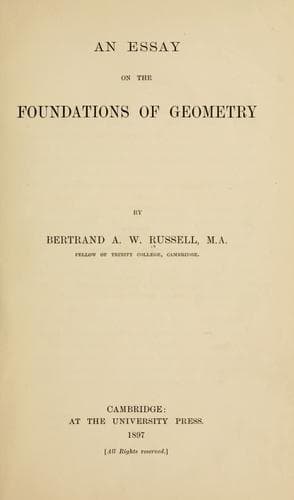
An essay on the foundations of geometryRussell, Bertrand
Philosophy
An essay on the foundations of geometry
Russell, Bertrand
Geometry -- Foundations
In the first place, what does Kant's doctrine mean for Geometry?
Obviously not the aspect of the doctrine which has been attacked by
psychologists, the "Kantian machine-shop" as James calls it--at any
rate, if this can be clearly separated from the logical aspect. The
question whether space is given in sensation, or whether, as Kant
maintained, it is given by an intuition to which no external matter
corresponds, may for the present be disregarded. If, indeed, we
held the view which seems crudely to sum up the standpoint of the
Critique, the view that all certain knowledge is self-knowledge,
then we should be committed, if we had decided that Geometry was
apodeictic, to the view that space is subjective. But even then, the
psychological question could only arise when the epistemological
question had been solved, and could not, therefore, be taken into
account in our first investigation. The question before us is
precisely the question whether, or how far, Geometry is apodeictic,
and for the moment we have only to investigate this question, without
fear of psychological consequences.
=53.= Now on this question, as on almost all questions in the
Aesthetic or the Analytic, Kant's argument is twofold. On the one
hand, he says, Geometry is known to have apodeictic certainty:
therefore space must be _à priori_ and subjective. On the other hand,
it follows, from grounds independent of Geometry, that space is
subjective and _à priori_; therefore Geometry must have apodeictic
certainty. These two arguments are not clearly distinguished in the
Aesthetic, but a little analysis, I think, will disentangle them.
Thus in the first edition, the first two arguments deduce, from
non-geometrical grounds, the apriority of space; the third deduces
the apodeictic certainty of Geometry, and maintains, conversely,
that no other view can account for this certainty[69]; the last two
arguments only maintain that space is an intuition, not a concept.
In the second edition, the double argument is clearer, the apriority
of space being proved independently of Geometry in the metaphysical
deduction, and deduced from the certainty of Geometry, as the only
possible explanation of this, in the transcendental deduction. In the
Prolegomena, the latter argument alone is used, but in the Critique
both are employed.
Public-domain text, read in full here on John Shaqi.
Reviews
Reviews
No reviews yet
Be the first to share your thoughts on this work.
Elsewhere in the archive
Join the Discussion
Join the discussion
Sign in to leave a comment or review.
Sign InorCreate an account