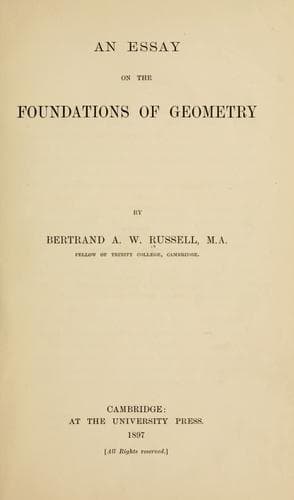
An essay on the foundations of geometryRussell, Bertrand
Philosophy
An essay on the foundations of geometry
Russell, Bertrand
Geometry -- Foundations
=54.= Now it must be admitted, I think, that Metageometry has
destroyed the legitimacy of the argument from Geometry to space; we
can no longer affirm, on purely geometrical grounds, the apodeictic
certainty of Euclid. But unless Metageometry has done more than
this--unless it has proved, what I believe it alone cannot prove,
that Euclid has _not_ apodeictic certainty--then Kant's other line
of argument retains what force it may ever have had. The actual
space we know, it may say, is admittedly Euclidean, and is proved,
without any reference to Geometry, to be _à priori_; _hence_ Euclid
has apodeictic certainty, and non-Euclid stands condemned. To this
it is no answer to urge, with the Metageometers, that non-Euclidean
systems are _logically_ self-consistent; for Kant is careful to argue
that geometrical reasoning, by virtue of our intuition of space, is
synthetic, and cannot, though _à priori_, be upheld by the principle
of contradiction alone[70]. Unless non-Euclideans can prove, what
they have certainly failed to prove up to the present, that we can
frame an _intuition_ of non-Euclidean spaces, Kant's position cannot
be upset by Metageometry alone, but must also be attacked, if it is
to be successfully attacked, on its purely philosophical side.
=55.= For such an attack, two roads lie open: either we may disprove
the first two arguments of the Aesthetic, or we may criticize, from
the standpoint of general logic, the Kantian doctrine of synthetic
_à priori_ judgments and their connection with subjectivity. Both
these attacks, I believe, could be conducted with some success;
but if we are to disprove the apodeictic certainty of Geometry,
one or other is essential, and both, I believe, will be found only
partially successful. It will be my aim to prove, in discussing
these two lines of attack, (1) that the distinction of synthetic and
analytic judgments is untenable, and further, that the principle of
contradiction can only give fruitful results on the assumption that
experience in general, or, in a particular science, some special
branch of experience, is to be formally possible; (2) that the first
two arguments of the Transcendental Aesthetic suffice to prove,
not Euclidean space, but _some_ form of externality--which may be
sensational or intuitional, but not merely conceptual--a necessary
prerequisite of experience of an external world. In the third and
fourth chapters, I shall contend, as a result of these conclusions,
that those axioms, which Euclid and Metageometry have in common,
coincide with those properties of any form of externality which are
deducible, by the principle of contradiction, from the possibility of
experience of an external world. These properties, then, may be said,
though not quite in the Kantian sense, to be _à priori_ properties of
space, and as to these, I think, a modified Kantian position may be
maintained. But the question of the subjective or objective nature
Public-domain text, read in full here on John Shaqi.
Reviews
Reviews
No reviews yet
Be the first to share your thoughts on this work.
Elsewhere in the archive
Join the Discussion
Join the discussion
Sign in to leave a comment or review.
Sign InorCreate an account