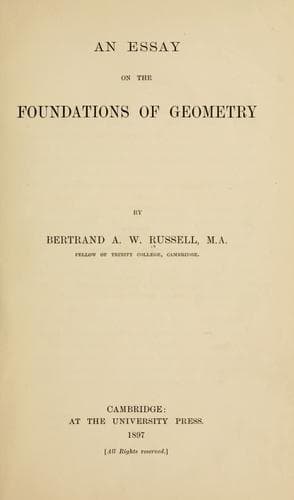
An essay on the foundations of geometryRussell, Bertrand
Philosophy
An essay on the foundations of geometry
Russell, Bertrand
Geometry -- Foundations
=60.= The aim of Riemann's dissertation, as we saw in Chapter I.,
was to define space as a species of manifold, _i.e._ as a particular
kind of collection of magnitudes. It was thus assumed, to begin with,
that spatial figures could be regarded as magnitudes, and the axioms
which emerged, accordingly, determined only the particular place of
these among the many algebraically possible varieties of magnitudes.
The resulting formulation of the axioms--while, from the mathematical
standpoint of metrical Geometry, it was almost wholly laudable--must,
from the standpoint of philosophy, be regarded, in my opinion, as a
_petitio principii_. For when we have arrived at regarding spatial
figures as magnitudes, we have already traversed the most difficult
part of the ground. The axioms of metrical Geometry--and it is
metrical Geometry, exclusively, which is considered in Riemann's
Essay--will appear, in Chapter III., to be divisible into two
classes. Of these, the first class--which contains the axioms common
to Euclid and Metageometry, the only axioms seriously discussed by
Riemann--are not the results of measurement, nor of any conception
of magnitude, but are conditions to be fulfilled before measurement
becomes possible. The second class only--those which express the
difference between Euclidean and non-Euclidean spaces--can be
deduced as results of measurement or of conceptions of magnitude.
As regards the first class, on the contrary, we shall see that
the relativity of position--by which space is distinguished from
all other known manifolds, except time--leads logically to the
necessity of three of the most distinctive axioms of Geometry, and
yet this relativity cannot be called a deduction from conceptions of
magnitude. In analytical Geometry, owing to the fact that coordinate
systems start from points, and hence build up lines and surfaces, it
is easy to suppose that points can be given independently of lines
and of each other, and thus the relativity of position is lost sight
of. The error thus suggested by mathematics was probably reinforced
by Herbart's theory of space, which, by its serial character, as
we have seen, appeared to him to facilitate a construction out of
successive points, and to which Riemann acknowledges his indebtedness
both in his Dissertation and elsewhere. The same error reappears
in Helmholtz, in whom it is probably due wholly to the methods of
analytical Geometry. It is a striking fact that, throughout the
writings of these two men, there is not, so far as I know, one
allusion to the relativity of position, that property of space
from which, as our next chapter will shew, the richest quarry of
consequences can be extracted. This is not a result of any conception
of magnitude, but follows from the nature of our space-intuition; yet
no one, surely, could call it empirical, since it is bound up in the
very possibility of locating things _there_ as opposed to _here_.
Public-domain text, read in full here on John Shaqi.
Reviews
Reviews
No reviews yet
Be the first to share your thoughts on this work.
Elsewhere in the archive
Join the Discussion
Join the discussion
Sign in to leave a comment or review.
Sign InorCreate an account