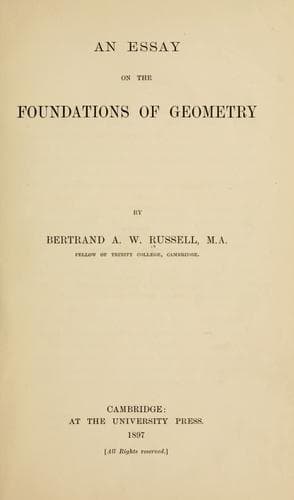
An essay on the foundations of geometryRussell, Bertrand
Philosophy
An essay on the foundations of geometry
Russell, Bertrand
Geometry -- Foundations
=61.= Indeed we can see, from a purely logical consideration of
the judgment of quantity, that Riemann's manner of approaching the
problem can never, by legitimate methods, attain to a philosophically
sound formulation of the axioms. For quantity is a result of
comparison of two qualitatively similar objects, and the judgment of
quantity neglects altogether the qualitative aspect of the objects
compared. Hence a knowledge of the essential properties of space can
never be obtained from judgments of quantity, which neglect these
properties, while they yet presuppose them. As well might one hope
to learn the nature of man from a census. Moreover, the judgment of
quantity is the result of comparison, and therefore presupposes
the possibility of comparison. To know whether, or by what means,
comparison is possible, we must know the qualities of the things
compared and of the medium in which comparison is effected; while to
know that _quantitative_ comparison is possible, we must know that
there is a qualitative identity between the things compared, which
again involves a previous qualitative knowledge. When spatial figures
have once been reduced to quantity, their quality has already been
neglected, as known and similar to the quality of other figures. To
hope, therefore, for the qualities of space, from a comparison of its
expression as pure quantity with other pure quantities, is an error
natural to an analytical geometer, but an error, none the less, from
which there is no return to the qualitative basis of spatial quantity.
=62.= We must entirely dissent, therefore, from the disjunction which
underlies Riemann's philosophy of space. Either the axioms must be
consequences of general conceptions of magnitude, he thinks, or
else they can only be proved by experience (p. 255). Whatever _can_
be derived from general conceptions of magnitude, we may retort,
cannot be an _à priori_ adjective of space: for all the necessary
adjectives of space are presupposed in any judgment of spatial
quantity, and cannot, therefore, be consequences of such a judgment.
Riemann's disjunction, accordingly, since one of its alternatives is
obviously impossible, really begs the question. In formulating the
axioms of metrical Geometry, our question should be: What axioms,
_i.e._ what adjectives of space, must be presupposed, in order that
quantitative comparison of the parts of space may be possible at
all? And only when we have determined these conditions, which are
_à priori_ necessary to any quantitative science of space, does the
second question arise: what inferences can we draw, as to space,
from the observed results of this quantitative science, _i.e._ of
this measurement of spatial figures? The conditions of measurement
themselves, though not results of any conception of magnitude, will
be _à priori_, if it can be shown that, without them, experience of
externality would be impossible.
Public-domain text, read in full here on John Shaqi.
Reviews
Reviews
No reviews yet
Be the first to share your thoughts on this work.
Elsewhere in the archive
Join the Discussion
Join the discussion
Sign in to leave a comment or review.
Sign InorCreate an account