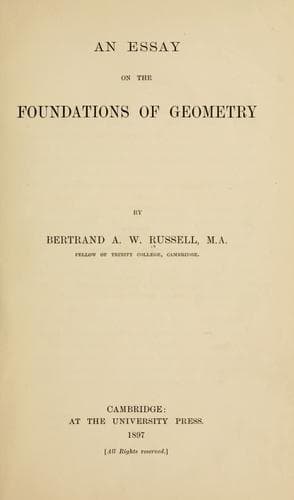
An essay on the foundations of geometryRussell, Bertrand
Philosophy
An essay on the foundations of geometry
Russell, Bertrand
Geometry -- Foundations
After this initial protest against Riemann's general philosophical
position, let us proceed to examine, in detail, his use of the notion
of a manifold.
=63.= In the first place there is, if I am not mistaken, considerable
obscurity in the definition of a manifold, of which an almost verbal
rendering was given in Chapter I. What is meant, to begin with, by
a general conception capable of various determinations? Does not
this property belong to all conceptions? It affords, certainly,
a basis for counting, but if continuous quantity is to arise, we
must, surely, have some less discrete formulation. It might afford
a basis, for example, for the distinction of points in projective
Geometry, but projective Geometry has nothing to do with quantity.
Something more fluid and flexible than a conception, one would think,
is necessary as the basis of continua. Then, again, what is meant by
a quantum of a manifold? In space, the answer is obvious: what is
meant is a piece of volume. But how about Riemann's other continuous
manifold, colour? Does a quantum of colour mean a single line in the
spectrum, or a band of finite thickness? In either case, what are
the magnitudes to be compared? And how is superposition necessary,
or even possible? A colour is fixed by its position in the spectrum:
two lines in the same spectrum cannot be superposed, and two lines in
different spectra need not be--their positions in their respective
spectra suffice, or even, roughly, their immediate sense-quality. The
fact is, Riemann had space in his mind from the start, and many of
the properties, which he enunciates as belonging to all manifolds,
belong, as a matter of fact, only to space. It is far from clear what
the magnitudes are which the various determinations make possible.
Do these magnitudes measure the elements of the manifold, or the
relations between elements? This is surely a very fundamental point,
but it is one which Riemann never touches on. In the former case,
the superposition which he speaks of becomes unnecessary, since the
magnitude is inherent in the element considered. We do not require
superposition to measure quantities corresponding to different tones
or colours; these can be discovered by analysis of single tones or
colours. With space, on the other hand, if we seek for elements,
we can find none except points, and no analysis of a point will
find magnitudes inherent in it--such magnitudes are a fiction of
coordinate Geometry. The magnitudes which space deals with, as we
shall see in Chapter III., are relations between points, and it is
for this reason that superposition is essential to space-measurement.
There is no inherent quality in a single point, as there is in a
single colour, by which it can be quantitatively distinguished from
another. Thus the conception of a manifold, as defined by Riemann,
either does not include colours, or does not involve superposition as
the only means of measurement. From this dilemma there is no escape.
Public-domain text, read in full here on John Shaqi.
Reviews
Reviews
No reviews yet
Be the first to share your thoughts on this work.
Elsewhere in the archive
Join the Discussion
Join the discussion
Sign in to leave a comment or review.
Sign InorCreate an account