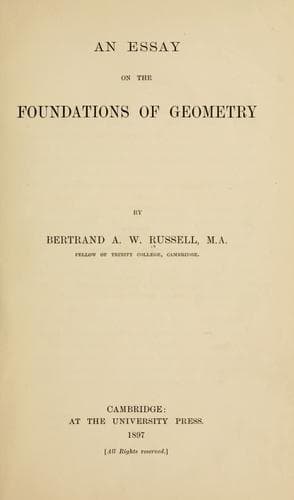
An essay on the foundations of geometryRussell, Bertrand
Philosophy
An essay on the foundations of geometry
Russell, Bertrand
Geometry -- Foundations
=64.= But if "measurement _consists_ in a superposition of the
magnitudes compared" (p. 256), does it not follow immediately that
measurement is logically possible _only_ where such superposition
leaves the magnitudes unchanged? And therefore that measurement, as
above defined, involves, as an _à priori_ condition, that magnitudes
are unchanged by motion? This consequence is not drawn by Riemann;
indeed he proceeds immediately (pp. 256-7) to consider what he calls
a general portion of the doctrine of magnitude (_Grössenlehre_),
independent of measurement. But how is any doctrine of magnitude
possible, in which the magnitudes cannot be measured? The reason
of the confusion is, that Riemann's definition of measurement is
applicable to no single manifold except space, since it depends
on the noteworthy property that what we measure in Geometry is
not points, but relations between points, and the latter, though
not the former, may of course be unaltered by motion. Let us try,
in illustration, to apply Riemann's definition of measurement to
colours. We must remember that motion, in dealing with the colour
manifold, means--not motion in space but--motion in the colour
manifold itself. Now since every point of the colour manifold is
completely determined by three magnitudes, which are given in fact,
and cannot be arbitrarily chosen, it is plain that measurement
by superposition--involving, as it does, motion, and therefore
change in these determining magnitudes--is totally out of the
question. The superposition of one colour on another, as a means
of measurement, is sheer nonsense. And yet measurement is possible
in the colour-manifold, by means of Helmholtz's law of mixture
(_Mischungsgesetz_); but the measurement is of every separate
element, not of the relations between elements, and is thus radically
different from space-measurement[81]. The elements are not, like
points in space, qualitatively alike, and distinguished by the
mere fact of their mutual externality. What we have, in colours, is
three fundamental qualitatively distinct elements, out of certain
proportions of which we can build up all the other elements of the
manifold--each of the resulting elements having the same combination
of qualitative diversity and similarity as the three original
elements. But in space, what could we make of such a procedure? Given
three points, how are we to combine them in certain proportions? The
phrase is meaningless. If some one makes the obvious retort, that we
have to combine lines, not points, my rejoinder is equally obvious.
To begin with, lines are not elements. Metaphysically, space has _no_
elements, being, as the sequel will show, mere relations between
non-spatial elements. Mathematically, this fact exhibits itself in
the self-contradictory notion of the point, or zero magnitude in
space, as the limit in our vain search for spatial elements. But
even if we allow the line to pass as the spatial element, what does
Public-domain text, read in full here on John Shaqi.
Reviews
Reviews
No reviews yet
Be the first to share your thoughts on this work.
Elsewhere in the archive
Join the Discussion
Join the discussion
Sign in to leave a comment or review.
Sign InorCreate an account