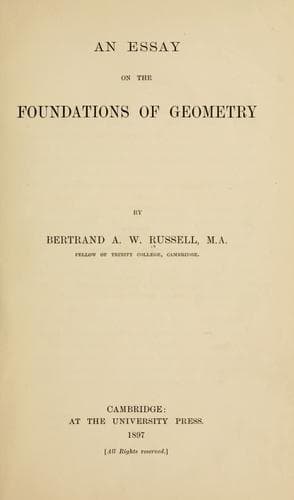
An essay on the foundations of geometryRussell, Bertrand
Philosophy
An essay on the foundations of geometry
Russell, Bertrand
Geometry -- Foundations
the combination of three lines in definite proportions give us? It
gives us, simply, the coordinates of a _point_. Here again we see a
great difference between the colour and space-manifolds. In colours,
the combination of magnitudes gives a new magnitude of the same
kind; in space, it defines, not a magnitude at all, but a would-be
element of a different kind from the defining magnitudes. In the
tone-manifold, we should find still different conditions. Here, no
one of the measuring magnitudes can vanish without the tone vanishing
too, and all three are so bound up together, in the single resulting
sensation, that none can exist without a finite quantity of the
others. They are all qualitatively different, both from each other,
and from any possible tone, being constituents of it, as mass and
velocity are constituents of momentum. All these different conditions
require to be examined, before a manifold can be completely defined;
and until we have conducted such an examination in detail, we cannot
pronounce as to the _à priori_ or empirical nature of the laws of the
manifold. As regards space, I have attempted such an examination in
the third and fourth chapters of this Essay.
=65.= I do not wish to deny, however, the great value of the
conception of space as a manifold. On the contrary, this conception
seems to have become essential to any treatment of the question.
I only wish to urge that the purely algebraical treatment of any
manifold, important as it may be in deducing fresh consequences from
known premisses, tends rather to conceal than to make clear the
basis of the premisses themselves, and is therefore misleading in a
philosophical investigation. For mathematics, where quantity reigns
supreme, Riemann's conception has proved itself abundantly fruitful;
for philosophy, on the contrary, where quantity appears rather as
a cloak to conceal the qualities it abstracts from, the conception
seems to me more productive of error and confusion than of sound
doctrine.
Public-domain text, read in full here on John Shaqi.
Reviews
Reviews
No reviews yet
Be the first to share your thoughts on this work.
Elsewhere in the archive
Join the Discussion
Join the discussion
Sign in to leave a comment or review.
Sign InorCreate an account