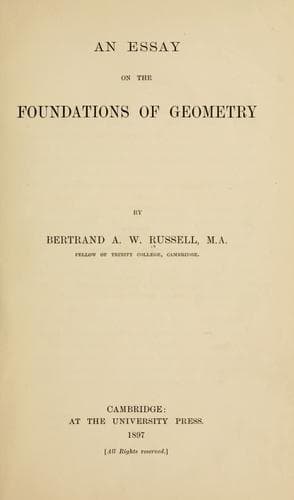
An essay on the foundations of geometryRussell, Bertrand
Philosophy
An essay on the foundations of geometry
Russell, Bertrand
Geometry -- Foundations
We are thus brought back to the point from which we started, namely,
the falsity of Riemann's initial disjunction, and the consequent
fallacy in his proof of the empirical nature of the axioms. His
philosophy is chiefly vitiated, to my mind, by this fallacy, and
by the uncritical assumption that a metrical coordinate system can
be set up independently of any axioms as to space-measurement[82].
Riemann has failed to observe, what I have endeavoured to prove in
the next chapter, that, unless space had a strictly constant measure
of curvature, Geometry would become impossible; also that the absence
of constant measure of curvature involves absolute position, which is
an absurdity. Hence he is led to the conclusion that all geometrical
axioms are empirical, and may not hold in the infinitesimal, where
observation is impossible. Thus he says (p. 267): "Now the empirical
conceptions, on which spatial measurements are based, the conceptions
of the rigid body and the light-ray, appear to lose their validity
in the infinitesimal: it is therefore quite conceivable that
the relations of spatial magnitudes in the infinitesimal do not
correspond to the presuppositions of Geometry, and this would, in
fact, have to be assumed, as soon as it would enable us to explain
the phenomena more simply." From this conclusion I must entirely
dissent. In very large spaces, there might be a departure from
Euclid; for they depend upon the axiom of parallels, which is not
contained in the axiom of Free Mobility; but in the infinitesimal,
departures from Euclid could only be due to the absence of Free
Mobility, which, as I hope my third chapter will show, is once for
all impossible.
Helmholtz.
=66.= Helmholtz, like Riemann, was important both in the mathematics
and in the philosophy of Geometry. From the mathematical point
of view, his work has been already considered in Chapter I.; the
consideration of his philosophy, which must occupy us here, will
be a more serious task. Like Riemann, he endeavoured to prove that
all the axioms are empirical, and like Riemann, he based his proof
chiefly on Metageometry. He had an additional resource, however,
in the physiology of the senses, which first led him to reject the
Transcendental Aesthetic, and enabled him to attack Kant from the
psychological as well as the mathematical side[83].
The principal topics, for a criticism of Helmholtz, are three: First,
his criterion of the _à priori_; second, his discussion with Land as
to the "imaginability" of non-Euclidean spaces; third--and this is by
far the most important of the three--his theory of the dependence of
Geometry on Mechanics. Let us discuss these three points successively.
Public-domain text, read in full here on John Shaqi.
Reviews
Reviews
No reviews yet
Be the first to share your thoughts on this work.
Elsewhere in the archive
Join the Discussion
Join the discussion
Sign in to leave a comment or review.
Sign InorCreate an account