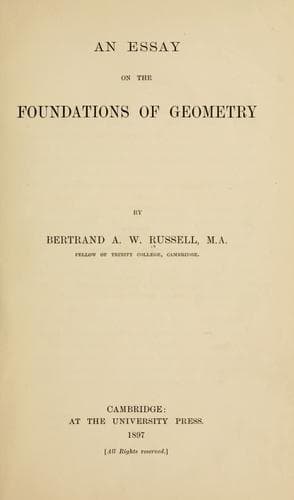
An essay on the foundations of geometryRussell, Bertrand
Philosophy
An essay on the foundations of geometry
Russell, Bertrand
Geometry -- Foundations
Another and a better criterion, it is true, is also to be found in
Helmholtz, and has also been adopted by Erdmann. Whatever might,
by a different experience, have been rendered different--so this
criterion contends--must itself be dependent on experience, and so
empirical. This criterion seems perfectly sound, but Helmholtz's use
of it is usually vitiated by his neglecting to prove the possibility
of the different experience in question. He says, for example, that
if our experience showed us only bodies which changed their shapes
in motion, we should not arrive at the axiom of Congruence, which
he pronounces accordingly to be empirical. But I shall endeavour
to prove, in Chapter III., that without the axiom of Congruence,
experience of spatial magnitude would be impossible. If my proof
be correct, it follows that no experience can ever reveal spatial
magnitudes which contradict this axiom--a possibility which Helmholtz
nowhere discusses, in setting up his hypothetical experience. Thus
this second criterion, though perfectly sound, requires always
an accompanying transcendental argument, as to the conditions of
possible experience. But this accompaniment is seldom to be found in
Helmholtz.
=68.= One of the few cases, in which Helmholtz has attempted such
an accompaniment, occurs in connection with our second point, the
imaginability of non-Euclidean spaces. The argument on this point
was elicited by Helmholtz's Kantian opponents, who maintained that
the merely logical possibility of these spaces was irrelevant, since
the basis of Geometry was not logic, but intuition. The axioms,
they said, are synthetic propositions, and their contraries are,
therefore, not self-contradictory; they are nevertheless apodeictic
propositions, since no other _intuition_ than the Euclidean is
possible to us[87]. I have already criticized this line of argument
in the beginning of the present chapter. Helmholtz's criticism,
however, was different: admitting the internal consistency of
the argument, he denied one of its premisses. We _can_ imagine
non-Euclidean spaces, he said, though their unfamiliarity makes
this difficult. From this view it followed, of course, that Kant's
argument, even if it were formally valid, could not prove the
apriority of Euclidean space in particular, but only of that general
space which included Euclid and non-Euclid alike[88].
Public-domain text, read in full here on John Shaqi.
Reviews
Reviews
No reviews yet
Be the first to share your thoughts on this work.
Elsewhere in the archive
Join the Discussion
Join the discussion
Sign in to leave a comment or review.
Sign InorCreate an account