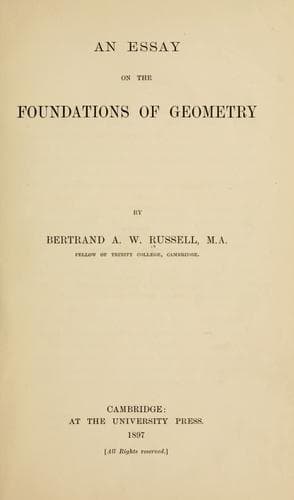
An essay on the foundations of geometryRussell, Bertrand
Philosophy
An essay on the foundations of geometry
Russell, Bertrand
Geometry -- Foundations
Although I agree with Helmholtz in thinking the distinction between
Euclidean and non-Euclidean spaces empirical, I cannot think his
argument on the "imaginability" of the latter a very happy one. The
validity of any proof must turn, obviously, on the definition of
imaginability. The definition which Helmholtz gives in his answer
to Land is as follows: Imaginability requires "die vollständige
Vorstellbarkeit derjenigen Sinneseindrücke, welche das betreffende
Object in uns nach den bekannten Gesetzen unserer Sinnesorgane
unter allen denkbaren Bedingungen der Beobachtung erregen, und
wodurch es sich von anderen ähnlichen Objecten unterscheiden würde"
(Wiss. Abh. II. p. 644). This definition is not very clear, owing
to the ambiguity of the word "_Vorstellbarkeit_." The following
definition seems less ambiguous: "Wenn die Reihe der Sinneseindrücke
vollständig und eindeutig angegeben werden kann, muss man m. E.
die Sache für _anschaulich vorstellbar_ erklären" (Vorträge und
Reden, II. p. 234). This makes clear, what also appears from his
manner of proof, that he regards things as imaginable which can be
_described_ in conceptual terms. Such, as Land remarks (Mind, Vol.
II. p. 45), "is not the sense required for argumentation in this
case." That Land's criticism is just, is shown by Helmholtz's proof
for non-Euclidean spaces, for it consists only in an analogy to
the volume inside a sphere, which is mathematically obtained thus:
We take the symbols representing magnitudes in "pseudo-spherical"
(hyperbolic) space, and give them a new Euclidean meaning; thus all
our symbolic propositions become capable of two interpretations,
one for pseudo-spherical space, and one for the volume inside a
sphere. It is, however, sufficiently obvious that this procedure,
though it enables us to _describe_ our new space, does not enable
us to _imagine_ it, in the sense of calling up images of the way
things would look in it. We really derive, from this analogy, no
more knowledge than a man born blind may derive, as to light,
from an analogy with heat. The dictum "Nihil est in intellectu
quod non fuerit ante in sensu," would unquestionably be true, if
for _intellect_ we were to substitute _imagination_; it is vain,
therefore, _if_ our actual space be Euclidean, to hope for a power of
_imagining_ a non-Euclidean space. What Helmholtz might, I believe
with perfect truth, have urged against Land, is that the image we
actually have of space is not sufficiently accurate to exclude, in
the actual space we know, all possibility of a slight departure from
the Euclidean type. But in maintaining that we cannot imagine, though
we can conceive and describe, a space different from that we actually
have, Land is, in my opinion, unquestionably in the right. For a
pure Kantian, who maintains, with Land, that none of the axioms can
be proved, this question is of great importance. But if, as I have
maintained, some of the axioms are susceptible of a transcendental
Public-domain text, read in full here on John Shaqi.
Reviews
Reviews
No reviews yet
Be the first to share your thoughts on this work.
Elsewhere in the archive
Join the Discussion
Join the discussion
Sign in to leave a comment or review.
Sign InorCreate an account