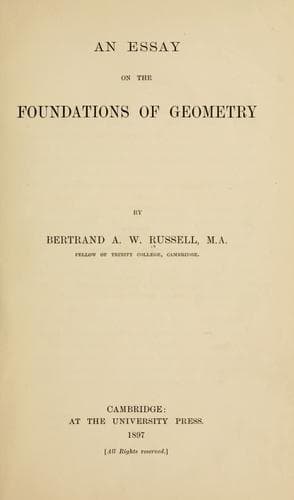
An essay on the foundations of geometryRussell, Bertrand
Philosophy
An essay on the foundations of geometry
Russell, Bertrand
Geometry -- Foundations
=70.= (1) Congruence may be taken to mean--as Helmholtz would
certainly seem to desire--that we find actual bodies, in our
mechanical experience, to preserve their shapes with approximate
constancy, and that we infer, from this experience, the homogeneity
of space. This view, in my opinion, radically misconceives the
nature of measurement, and of the axioms involved in it. For what
is meant by the non-rigidity of a body? We mean, simply, that
it has changed its shape. But this involves the possibility of
comparison with its former shape, in other words, of measurement.
In order, therefore, that there may be any question of rigidity
or non-rigidity, the measurement of spatial magnitudes must be
already possible. It follows that measurement cannot, without a
vicious circle, be itself derived from experience of rigid bodies.
Geometrical measurement, in fact, is the comparison of spatial
magnitudes, and such comparison involves, as will be proved at length
in Chapter III., the homogeneity of space. This is, therefore, the
logical prerequisite of all experience of rigid bodies, and cannot
be the result of such experience. Without the homogeneity of space,
the very notion of rigidity or non-rigidity could not exist, since
these mean, respectively, the constancy or inconstancy of spatial
magnitude in pieces of matter, and both alike, therefore, presuppose
the possibility of spatial measurement. From the homogeneity of
space, we learn that a body, when it moves, will not change its shape
without some physical cause; that it actually does not change its
shape, is never asserted, and is indeed known to be false. As soon as
measurement is possible, actual changes of shape can be estimated,
and their empirical causes can be sought. But if space were not
homogeneous, measurement would be impossible, constant shape would
be a meaningless phrase, and rigidity could never be experienced.
Congruence asserts, in short, that a body can, so far as mere space
is concerned, move without change of shape; rigidity asserts that
it actually does so move--a very different proposition, involving
obviously, as its logical prius, the former geometrical proposition.
Public-domain text, read in full here on John Shaqi.
Reviews
Reviews
No reviews yet
Be the first to share your thoughts on this work.
Elsewhere in the archive
Join the Discussion
Join the discussion
Sign in to leave a comment or review.
Sign InorCreate an account