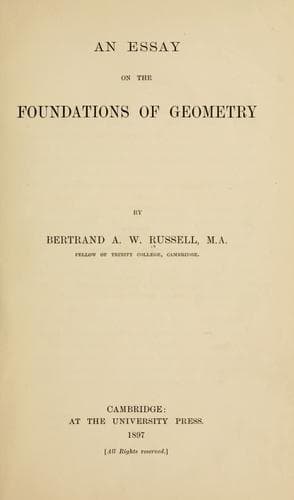
An essay on the foundations of geometryRussell, Bertrand
Philosophy
An essay on the foundations of geometry
Russell, Bertrand
Geometry -- Foundations
proof, while the others can be verified empirically, the question
is freed from psychological implications, and the imaginability or
non-imaginability of metageometrical spaces becomes unimportant.
=69.= We come now to the third and most important question, the
relation of Geometry to Mechanics. There are three senses in which
Helmholtz's appeal to rigid bodies may be taken: the first, I think,
is the sense in which he originally intended it; the second seems
to be the sense which he adopted in his defence against Land; while
the third is admitted by Land, and will be admitted in the following
argument. These three senses are as follows:
(1) It may be asserted that the actual meaning of the axiom of Free
Mobility lies in the assertion of empirical rigid bodies, and that
the two propositions are equivalent to one another. This is certainly
false.
(2) The axiom of Free Mobility, it may be said, is logically
distinguishable from the assertion of rigid bodies, and may even be
not empirical; but it is barren, even for pure Geometry, without the
aid of measures, which must themselves be empirical rigid bodies.
This sense is more plausible than the first, but I believe we can
show that, in this sense also, the proposition is false.
(3) For pure Geometry and the abstract study of space, it may be
said, Free Mobility, as applied to an abstract geometrical matter,
gives a sufficient possibility of quantitative comparison; but
the moment we extend our results to mixed mathematics, and apply
them to empirically given matter, we require also, as measures,
empirically given rigid bodies, or bodies, at least, whose departures
from rigidity are empirically known. In this sense, I admit, the
proposition is correct[89].
In discussing these three meanings, I shall not confine myself
strictly to the text of Helmholtz or Land: if I endeavoured to do so,
I should be met by the difficulty that neither of them defines the
_à priori_, and that each is too much inclined, in my opinion, to
test it by psychological criteria. I shall, therefore, take the three
meanings in turn, without laying stress on their historical adequacy
to the views of Land or Helmholtz.
Public-domain text, read in full here on John Shaqi.
Reviews
Reviews
No reviews yet
Be the first to share your thoughts on this work.
Elsewhere in the archive
Join the Discussion
Join the discussion
Sign in to leave a comment or review.
Sign InorCreate an account