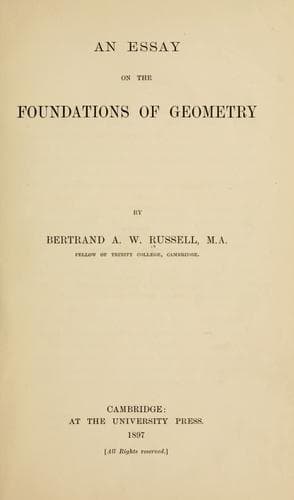
An essay on the foundations of geometryRussell, Bertrand
Philosophy
An essay on the foundations of geometry
Russell, Bertrand
Geometry -- Foundations
This conclusion, I believe, is valid of all actual measurement.
But the possibility of such empirical and approximate rigidity,
I must insist, depends on the _à priori_ law that _mere_ motion,
apart from the action of other matter, cannot effect a change of
shape. For without this law, the effect of other matter would not be
discoverable; the laws of motion would be absurd, and Physics would
be impossible. Consider the second law, for example: How could we
measure the change of motion, if motion itself produced a change
in our measures? Or consider the law of gravitation: How could we
establish the inverse square, unless we were able, independently
of Dynamics, to measure distances? The whole science of Dynamics,
in short, is fundamentally dependent on Geometry, and but for the
independent possibility of measuring spatial magnitudes, none of the
magnitudes of Dynamics could be measured. Time, force, and mass are
alike measured by spatial correlates: these correlates are given, for
time, by the first law, for force and mass, by the second and third.
It is true, then, that an empirical element appears unavoidably in
all actual measurement, inasmuch as we can only know empirically
that a given piece of matter preserves its shape throughout the
necessary change of dynamical relations to other matter involved in
motion; but it is further true that, for Geometry--which regards
matter simply as supplying the necessary breach in the homogeneity
of space, and the necessary term for spatial relations, not as the
bearer of forces which change the configuration of other material
systems--for Geometry, which deals with this abstract and merely
kinematical matter, rigidity is _à priori_, in so far as the only
changes with which it is cognizant--changes of mere position,
namely--are incapable of affecting the shapes of the imaginary and
abstract bodies with which it deals. To use a scholastic distinction,
we may say that matter is the _causa essendi_ of space, but Geometry
is the _causa cognoscendi_ of Physics. Without a Geometry independent
of Physics, Physics itself, which necessarily assumes the results of
Geometry, could never arise; but when Geometry is used in Physics, it
loses some of its _à priori_ certainty, and acquires the empirical
and approximate character which belongs to all accounts of actual
phenomena.
Public-domain text, read in full here on John Shaqi.
Reviews
Reviews
No reviews yet
Be the first to share your thoughts on this work.
Elsewhere in the archive
Join the Discussion
Join the discussion
Sign in to leave a comment or review.
Sign InorCreate an account