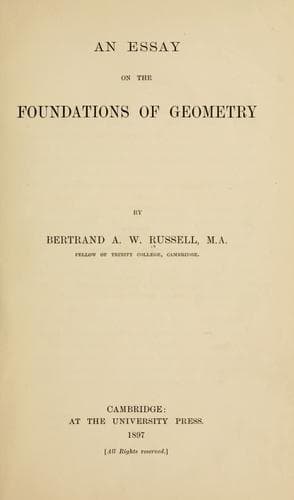
An essay on the foundations of geometryRussell, Bertrand
Philosophy
An essay on the foundations of geometry
Russell, Bertrand
Geometry -- Foundations
=72.= (3) This argument leads us to Land's distinction of physical
and geometrical rigidity. The distinction may be expressed--and
I think it is better expressed--by distinguishing between
the conceptions of matter proper to Dynamics and to Geometry
respectively. In Dynamics, we are concerned with matter as subject
to and as causing motion, as affected by and as exerting _force_. We
are therefore concerned with the changes of spatial configuration to
which material systems are liable: the description and explanation
of these changes is the proper subject-matter of all Dynamics. But
in order that such a science may exist, it is obviously necessary
that spatial configuration should be already measurable. If this
were not the case, motion, acceleration and force would remain
perfectly indeterminate. Geometry, therefore, must already exist
before Dynamics becomes possible: to make Geometry dependent for its
possibility on the laws of motion or any of their consequences, is
a gross ὕστερον πρότερον. Nevertheless, as we have seen, some sort
of matter is essential to Geometry. But this geometrical matter is a
more abstract and wholly different matter from that of Dynamics. In
order to study space by itself, we reduce the properties of matter
to a bare minimum: we avoid entirely the category of causation,
so essential to Dynamics, and retain nothing, in our matter, but
its spatial adjectives[91]. The kind of rigidity affirmed of this
abstract matter--a kind which suffices for the theory of our
science, though not for its application to the objects of daily
life--is purely geometrical, and asserts no more than this: That
since our matter is devoid, _ex hypothesi_, of causal properties,
there remains nothing, in mere empty space, which is capable of
changing the configuration of any geometrical system. A change of
absolute position, it asserts, is nothing; therefore the only real
change involved in motion is a change of relation to other matter;
but such other matter, for the purposes of our science, is regarded
as destitute of causal powers; hence no change can occur, in the
configuration of our system, by the mere effect of motion through
empty space. The necessity of such a principle may be shown by a
simple _reductio ad absurdum_, as follows. A motion of translation
of the universe as a whole, with constant direction and velocity, is
dynamically negligeable; indeed it is, philosophically, no motion at
all, for it involves no change in the condition or mutual relations
of the things in the universe. But if our geometrical rigidity
were denied, the change in the parameter of space might cause all
bodies to change their shapes owing to the mere change of absolute
position, which is obviously absurd.
Public-domain text, read in full here on John Shaqi.
Reviews
Reviews
No reviews yet
Be the first to share your thoughts on this work.
Elsewhere in the archive
Join the Discussion
Join the discussion
Sign in to leave a comment or review.
Sign InorCreate an account