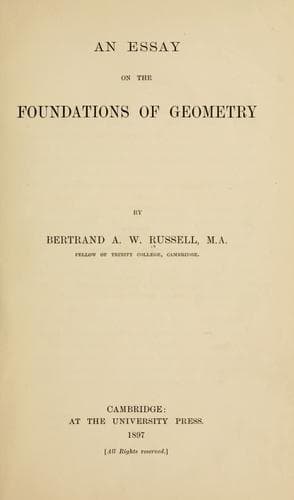
An essay on the foundations of geometryRussell, Bertrand
Philosophy
An essay on the foundations of geometry
Russell, Bertrand
Geometry -- Foundations
Thus, to conclude: Geometry requires, if it is to be _practically_
possible, some body or bodies which are either rigid (in the
dynamical sense), or known to undergo some definite changes of shape
according to some definite law. (These changes, we may suppose,
are known by the laws of Physics, which have been experimentally
established, and which throughout assume the truth of Geometry.)
One or more such bodies are necessary to applied Geometry--but only
in the sense in which rulers and compasses are necessary. They are
necessary as, in making the Ordnance Survey, an elaborate apparatus
was necessary for measuring the base line on Salisbury Plain. But
for the _theory_ of Geometry, geometrical rigidity suffices, and
geometrical rigidity means only that a shape, which is possible in
one part of space, is possible in any other. The empirical element
in practice, arising from the purely empirical nature of physical
rigidity, is comparable to the empirical inaccuracies arising from
the failure to find straight lines or circles in the world--which no
one but Mill has regarded as rendering Geometry itself empirical or
inaccurate. But to make Geometry await the perfection of Physics,
is to make Physics, which depends throughout on Geometry, forever
impossible. As well might we leave the formation of numbers until we
had counted the houses in Piccadilly.
Erdmann.
=74.= In connection with Riemann and Helmholtz, it is natural to
consider Erdmann's philosophical work on their theories[92]. This is
certainly the most important book on the subject which has appeared
from the philosophical side, and in spite of the fact that, like
the whole theory of Riemann and Helmholtz, it is inapplicable to
projective Geometry, it still deserves a very full discussion.
Erdmann agrees throughout with the conclusions of Riemann and
Helmholtz, except on a few points of minor importance; and his views,
as this agreement would lead one to expect, are ultra-empirical.
Indeed his logic seems--though I say this with hesitation--to be
incompatible with any system but that of Mill: there is apparently
no distinction, to him, between the general and the universal, and
consequently no concept not embodied in a series of instances. Such
a theory of logic, to my mind, vitiates most of his work, as it
vitiated Riemann's philosophy[93]. This general criticism will find
abundant illustration in the course of our account of Erdmann's views.
Public-domain text, read in full here on John Shaqi.
Reviews
Reviews
No reviews yet
Be the first to share your thoughts on this work.
Elsewhere in the archive
Join the Discussion
Join the discussion
Sign in to leave a comment or review.
Sign InorCreate an account