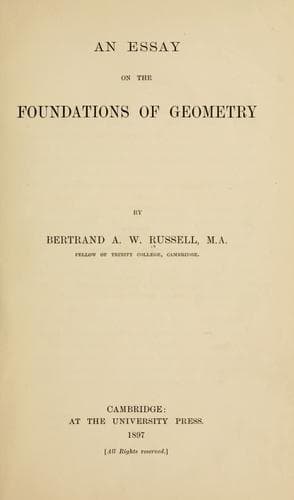
An essay on the foundations of geometryRussell, Bertrand
Philosophy
An essay on the foundations of geometry
Russell, Bertrand
Geometry -- Foundations
To make quite plain the function of rigid bodies in Geometry, let us
suppose a liquid geometer in a liquid world. We cannot suppose the
liquid perfectly homogeneous and undifferentiated, in the first place
because such a liquid would be indistinguishable from empty space,
in the second place because our geometer's body--unless he be a
disembodied spirit--will itself constitute a differentiation for him.
We may therefore assume
"dim beams,
Which amid the streams
Weave a network of coloured light,"
and we may suppose this network to form the occasion for our
geometer's reflections. Then he will be able to imagine a network
in which the lines are straight, or circular, or parabolic, or any
other shape, and he will be able to infer that such a network, if it
can be woven in one part of the fluid, can be woven in another. This
will form sufficient basis for his deductions. The superposition he
is concerned with--since not actual equality, but only the formal
conditions of equality, are the subject-matter of Geometry--is purely
ideal, and is unaffected by the impossibility of congealing any
actual network. But in order to apply his Geometry to the exigencies
of life, he would need some standard of comparison between actual
networks, and here, it is true, he would need either a rigid body,
or a knowledge of the conditions under which similar networks arose.
Moreover these conditions, being necessarily empirical, could hardly
be known apart from previous measurement. Hence for applied, though
not for pure Geometry, one rigid body at least seems essential.
=73.= The utility, for Dynamics, of our abstract geometrical matter,
is sufficiently evident. For having, by its means, a power of
determining the configurations of material systems in whatever part
of space, and knowing that changes of configuration are not due to
mere change of place, we are able to attribute these changes to the
action of other matter, and thus to establish the notion of force,
which would be impossible if change of shape might be due to empty
space.
Public-domain text, read in full here on John Shaqi.
Reviews
Reviews
No reviews yet
Be the first to share your thoughts on this work.
Elsewhere in the archive
Join the Discussion
Join the discussion
Sign in to leave a comment or review.
Sign InorCreate an account