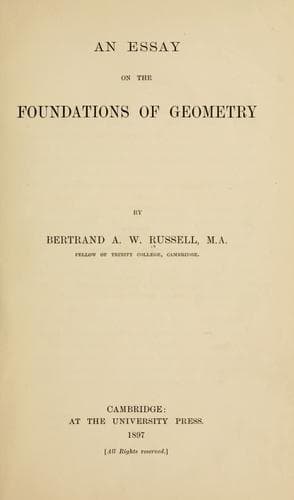
An essay on the foundations of geometryRussell, Bertrand
Philosophy
An essay on the foundations of geometry
Russell, Bertrand
Geometry -- Foundations
=77.= As regards the first point, it is to be observed that people
certainly had some conception of space before Riemann invented
the notion of a manifold, and that this conception was certainly
something other than the common qualities of all the points, lines
or figures in space. In the second place, Erdmann's view would
make it impossible to conceive God, unless one were a polytheist,
or the universe--unless, like Leibnitz, one imagined a series of
possible worlds, set over against God, and none of them, therefore,
a true Universe--or, to take an instance more likely to appeal to an
empiricist, the necessarily unique centre of mass of the material
universe. Any universal, in short, which is a bond or unity between
things, and not merely a common property among independent objects,
becomes impossible on Erdmann's view. We cannot, therefore, unless
we adopt Mill's philosophy intact, regard the conception of space
as demanding a series of instances from which to abstract. But even
if we did so regard it, Riemann's manifolds would leave us without
resources. For Euclidean space still appears as unique, at the end of
his series of determinations. We have instances of manifolds, but not
instances of Euclidean space. Thus if Erdmann's theory of conceptions
were correct, he would still be left searching in vain for the
conception of Euclidean space.
=78.= The second point, the view that all definition is
classification, is closely allied to the first, and the two together
plunge us into the depths of scholastic formal logic. The same
instances of things which could not, on Erdmann's view, be conceived,
may now be adduced as things which cannot be defined. Whatever was
said above applies here also, and the point need not, therefore, be
further discussed[94].
=79.= As regards the third point, the impossibility of applying
conceptions of magnitude to space as a whole, a longer argument will
be necessary, for we are concerned, here, with the whole question
of the logical nature of judgments of magnitude. As we had before
too much comparison for our needs, so we have now too little. I will
endeavour to explain this point, which is of great importance, and
underlies, I think, most of the philosophical fallacies of Riemann's
school.
Public-domain text, read in full here on John Shaqi.
Reviews
Reviews
No reviews yet
Be the first to share your thoughts on this work.
Elsewhere in the archive
Join the Discussion
Join the discussion
Sign in to leave a comment or review.
Sign InorCreate an account