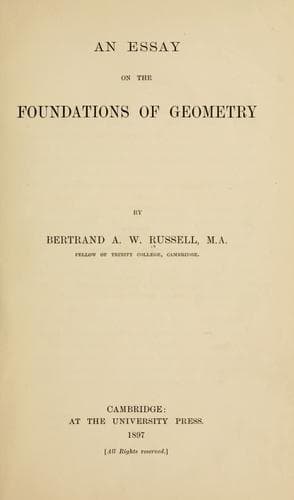
An essay on the foundations of geometryRussell, Bertrand
Philosophy
An essay on the foundations of geometry
Russell, Bertrand
Geometry -- Foundations
A judgment of magnitude is always a judgment of comparison, and what
is more, the comparison is never concerned with quality, but only
with quantity. Quality, in the judgment of magnitude, is supposed
identical, in the object whose magnitude is stated, and in the unit
with which it is compared. But quality, except in pure number, and in
pure quantity as dealt with by the Calculus, is always present, and
is partly absorbed into quantity, partly untouched by the judgment of
magnitude. As Bosanquet says (Logic, Vol. I. p. 124); "Quantitative
comparison is not _prima facie_ coordinate with qualitative,
but rather stands in its place as the _effect of comparison on
quality_, which so far as comparable _becomes quantity_, and so
far as incomparable furnishes the distinction of parts essential
to the quantitative whole" (italics in the original). Thus, if we
are to regard space as a magnitude, we must be able to adduce all
those series of instances of which Erdmann speaks, and which, for
the conception of space, seemed irrelevant. But it remains to be
proved that the comparison, which we _can_ institute between various
spaces, is capable of expression in a quantitative form. Rather it
would seem that the difference of quality is such as to preclude
quantitative comparison between different spaces, and therefore also
to preclude all judgments of magnitude about space as a whole. Here
an exception might seem to be demanded by non-Euclidean spaces,
whose space-constants give a definite magnitude, inherent in space
as a whole, and therefore, one might think, characterizing space as
a magnitude. But this is a mistake. For the space-constant, in such
spaces, is the ultimate unit, the fixed term in all quantitative
comparison; it is itself, therefore, destitute of quantity, since
there is no independently given magnitude with which to compare it.
A non-Euclidean world, in which the space-constant and all lines
and figures were suddenly multiplied in a constant ratio, would be
wholly unchanged; the lines, as measured against the space-constant,
would have the same magnitude as before, and the space-constant
itself, having no outside standard of comparison, would be destitute
of quantity, and therefore not subject to change of quantity. Such an
enlargement of a non-Euclidean world, in other words, is unmeaning;
and this proves how inapplicable is the notion of quantity to space
as a whole.
Public-domain text, read in full here on John Shaqi.
Reviews
Reviews
No reviews yet
Be the first to share your thoughts on this work.
Elsewhere in the archive
Join the Discussion
Join the discussion
Sign in to leave a comment or review.
Sign InorCreate an account