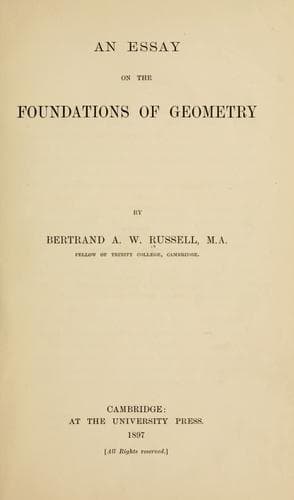
An essay on the foundations of geometryRussell, Bertrand
Philosophy
An essay on the foundations of geometry
Russell, Bertrand
Geometry -- Foundations
=81.= After this protest against the initial assumptions in Erdmann's
deduction of space, let us return to consider the manner, in which
this deduction is carried out. Here there will be less ground
for criticism, as the deduction, given its presuppositions, is,
I think, as good as such a deduction can be. To define space as
a magnitude, he says, let us start with two of its most obvious
properties, continuity and the three dimensions. Tones and colours
afford other instances of a manifold with these two properties, but
differ from space in that their dimensions are not homogeneous and
interchangeable. To designate this difference, Erdmann introduces
a useful pair of terms: in the general case, he calls a manifold
_n_-determined (n-_bestimmt_); in the case where, as in space, the
dimensions are homogeneous, he calls the manifold _n_-extended
(n-_ausgedehnt_). Manifolds of the latter sort he calls extents
(_Ausgedehntheiten_). That the difference between the two kinds
is one of quality, not of quantity, he seems not to perceive; he
also overlooks the fact that, in the second kind, from its very
definition, the axiom of Congruence must hold, on account of the
qualitative similarity of different parts. In spite of this fact, he
defines space as an extent, and then regards Congruence as empirical,
and as possibly false in the infinitesimal. This is the more strange,
as he actually proves (p. 50) that measurement is impossible, in an
extent, unless the parts are independent of their place, and can be
carried about unaltered as measures. In spite of this, he proceeds
immediately to discuss whether the measure of curvature is constant
or variable, without investigating how, in the latter case, Geometry
could exist. We cannot know, he says, from geometrical superposition,
that geometrical bodies are independent of place, for if their
dimensions altered in motion according to any fixed law, two bodies
which could be superposed in one place could be superposed in any
other. That such a hypothesis involves absolute position, and denies
the qualitative similarity of the parts of space, which he declares
(p. 171) to be the principle of his theory of Geometry, is nowhere
perceived. But what is more, his notion that magnitude is something
absolute, independent of comparison, has prevented him from seeing
that such a hypothesis is unmeaning. He says himself that, even on
this hypothesis, a geometrical body can be defined as one whose
points retain constant distances from each other, for, since we have
no absolute measure, measurement could not reveal to us the change of
absolute magnitude (p. 60). But is not this a _reductio ad absurdum_?
For magnitude is nothing apart from comparison, and the comparison
here can only be effected by superposition; if, then, as on the above
hypothesis, superposition always gives the same result, by whatever
motion it is effected, there is no sense in speaking of magnitudes as
Public-domain text, read in full here on John Shaqi.
Reviews
Reviews
No reviews yet
Be the first to share your thoughts on this work.
Elsewhere in the archive
Join the Discussion
Join the discussion
Sign in to leave a comment or review.
Sign InorCreate an account