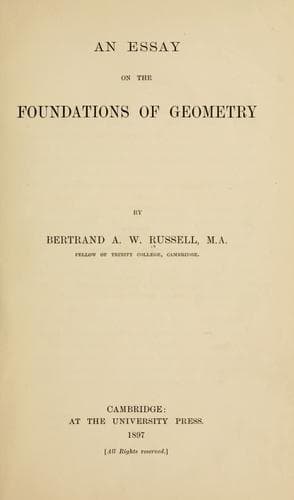
An essay on the foundations of geometryRussell, Bertrand
Philosophy
An essay on the foundations of geometry
Russell, Bertrand
Geometry -- Foundations
It might be objected that this only proves the absence of
quantitative difference between different spaces of positive
space-constant, or between those of negative space-constant: the
quantitative difference persists, it might be said, between those
of positive curvature in general and those of negative curvature
in general, or between both together and Euclidean space. This I
entirely deny. There is no qualitatively similar unit, in the three
kinds of space, by which quantitative comparison could be effected.
The straight lines of one space cannot be put into the other: the
two straight lines, in one space, whose product is the reciprocal
of the measure of curvature, have no corresponding curves in the
other space, and the measures of curvature cannot, therefore,
be quantitatively compared with each other. That the one may be
regarded as positive, the other negative, I admit, but their values
are indeterminate, and the units in the two cases are qualitatively
different. A debt of £300 may be represented as the asset of -£300,
and the height of the Eiffel Tower is +300 metres; but it does
not follow that the two are quantitatively comparable. So with
space-constants: the space-constant is itself the unit for magnitudes
in its own space, and differs qualitatively from the space-constant
of another kind of space.
Again, to proceed to a more philosophical argument, two different
spaces cannot co-exist in the same world: we may be unable to decide
between the alternatives of the disjunction, but they remain, none
the less, absolutely incompatible alternatives. Hence we cannot get
that coexistence of two spaces which is essential to comparison. The
fact seems to be that Erdmann, in his admiration for Riemann and
Helmholtz, has fallen in with their mathematical bias, and assumed,
as mathematicians naturally tend to assume, that quantity is
everywhere and always applicable and adequate, and can deal with more
than the mere comparison of things whose qualities are already known
as similar[95].
=80.= This suggests the fourth and last of the above points, that the
_qualities_ of space, even if space could be successfully regarded
as a magnitude, would have to be entirely omitted in such a manner
of regarding it, and that, therefore, none of its important or
essential properties would emerge from such treatment. For to regard
space as a magnitude involves, as we saw, a comparison with something
qualitatively similar, and an abstraction from the similar qualities.
To some extent and by the help of certain doubtful arguments, such a
comparison is instituted by Riemann and Erdmann; but when they have
instituted it, they forget all about the common qualities on which
its possibility depends. But these are precisely the fundamental
properties of space, and those from which, as I shall endeavour to
prove in Chapter III., the axioms common to Euclid and Metageometry
follow _à priori_. Such are the dangers of the quantitative bias.
Public-domain text, read in full here on John Shaqi.
Reviews
Reviews
No reviews yet
Be the first to share your thoughts on this work.
Elsewhere in the archive
Join the Discussion
Join the discussion
Sign in to leave a comment or review.
Sign InorCreate an account