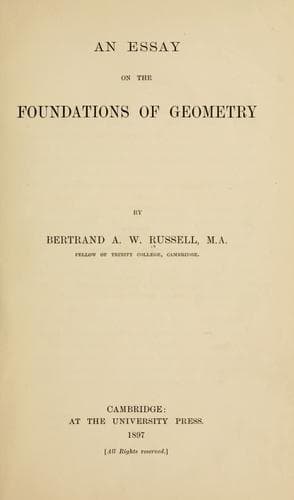
An essay on the foundations of geometryRussell, Bertrand
Philosophy
An essay on the foundations of geometry
Russell, Bertrand
Geometry -- Foundations
Erdmann's conclusion, in the second chapter, is that Congruence is
probable, but cannot be verified in the infinitesimal; that its truth
involves the actual existence of rigid bodies (though, by the way,
we know these to be, strictly speaking, non-existent), that rigid
bodies are freely moveable, and do not alter their size in rotation
(Helmholtz's Monodromy); that the axiom of three dimensions is
certain, since small errors are impossible; and that the remaining
axioms of Euclid--those of the straight line and of parallels--are
approximately, if not accurately, true of our actual space (pp.
78, 83). He does not discuss how Congruence, on the above view,
is compatible with the atomic theory, or even with the observed
deformations of approximately rigid bodies; nor how, if space, as he
assumes, is homogeneous, rigid bodies can fail to be freely moveable
through space. The axioms are all lumped together as empirical, and
it appears, in the following chapters, that Erdmann regards their
empirical nature as sufficiently proved by their applicability to
empirical material (cf. pp. 159, 165)--a strange criterion, which
would prove the same conclusion, with equal facility, of Arithmetic
and of the laws of thought.
=83.= The third chapter, on the philosophical consequences of
Metageometry, need not be discussed at length, since it deals rather
with space than with Geometry. At the same time, it will be worth
while to treat briefly of Erdmann's criterion of apriority. On this
subject it is very difficult to discover his meaning, since it
seems to vary with the topic he is discussing. Thus at one time (p.
147) he rejects most emphatically the Kantian connection of the _à
priori_ and the subjective[97], and yet at another time (p. 96) he
regards every presentation of external things as partly _à priori_,
partly empirical, merely because such a presentation is due to an
interaction between ourselves and things, and is therefore partly
due to subjective activity, partly due to outside objects. Hence,
he says, the distinction is not between different presentations,
but between different aspects of one and the same presentation.
This seems to return wholly to the Kantian psychological criterion
of subjectivity, with the added disadvantage that it makes the
distinction, like that of analytic and synthetic, epistemologically
worthless. And yet he never hesitates to pronounce every piece
of knowledge in turn empirical. The fact seems to be, that where
he wants a more logical criterion, he adopts a modification of
Helmholtz's criterion for sensations. If space be an _à priori_
form, he says, no experience could possibly change it (p. 108);
but this Metageometry has proved not to be the case, since we can
intuit the perceptions which non-Euclidean space would give us (p.
115). I have criticised this argument in discussing Helmholtz; at
present we are concerned with Erdmann's criterion of apriority. The
Public-domain text, read in full here on John Shaqi.
Reviews
Reviews
No reviews yet
Be the first to share your thoughts on this work.
Elsewhere in the archive
Join the Discussion
Join the discussion
Sign in to leave a comment or review.
Sign InorCreate an account