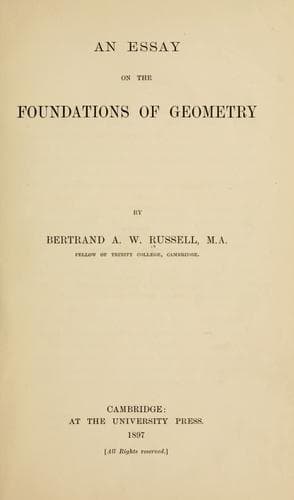
An essay on the foundations of geometryRussell, Bertrand
Philosophy
An essay on the foundations of geometry
Russell, Bertrand
Geometry -- Foundations
subjectivity-criterion--though he certainly uses it in discussing the
apriority of space, and solemnly decides, by its means, that space
is both _à priori_ and empirical since a change either in us or in
the outer world could change it (p. 97)--would seem, like several of
his other tests, to be a lapse on his part: the criterion which he
means to use is Helmholtz's. This criterion, I think, with a slight
change of wording, might be accepted; it seems to me a necessary,
but not a sufficient condition. The _à priori_, we may say, is not
only that which no experience can change, but that without which
experience would become impossible. It is the omission to discuss
the conditions which render geometrical (and mechanical) experience
possible, to my mind, which vitiates the empirical conclusions of
Helmholtz and Erdmann. Why certain conditions should be necessary
for experience--whether on account of the constitution of the mind,
or for some other reason--is a further question, which introduces
the relation of the _à priori_ to the subjective. But in discussing
the question as to what knowledge is _à priori_, as opposed to the
question concerning the further consequences of apriority, it is
well to keep to the purely logical criterion, and so preserve our
independence of psychological controversies. The fact, if it be a
fact, that the world might be such as to defy our attempts to know
it, will not, with the above criterion, invalidate the conclusion
that certain elements in knowledge are _à priori_; for whether
fulfilled or not, they remain necessary conditions for the existence
of any knowledge at all.
=84.= With this caution as to the meaning of apriority, we shall
find, I think, that the conclusions of Erdmann's final chapter, on
the principles of a theory of Geometry, are largely invalidated
by the diversity and inadequacy of his tests of the _à priori_.
He begins by asserting, in conformity with the quantitative bias
noticed above, that the question as to the nature of geometrical
axioms is completely analogous to the corresponding question of the
foundations of pure mathematics (p. 138). This is, I think, a radical
error: for the function of the axioms seems to be, to establish that
qualitative basis on which, as we saw, all qualitative comparison
must rest. But in pure mathematics, this qualitative basis is
irrelevant, for we deal there with pure quantity, _i.e._ with the
merely quantitative result of quantitative comparison, wherever it is
possible, independently of the qualities underlying the comparison.
Geometry, as Grassmann insists[98], ought not to be classed with
pure mathematics, for it deals with a matter which is given to the
intellect, not created by it. The axioms give the means by which
this matter is made amenable to quantity, and cannot, therefore, be
themselves deduced from purely quantitative considerations.
Public-domain text, read in full here on John Shaqi.
Reviews
Reviews
No reviews yet
Be the first to share your thoughts on this work.
Elsewhere in the archive
Join the Discussion
Join the discussion
Sign in to leave a comment or review.
Sign InorCreate an account