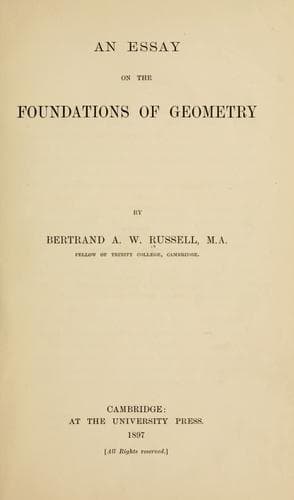
An essay on the foundations of geometryRussell, Bertrand
Philosophy
An essay on the foundations of geometry
Russell, Bertrand
Geometry -- Foundations
In the remainder of the chapter, Erdmann insists that the straight
line, etc., though not abstracted from experience, which nowhere
presents straight lines, must yet, as applicable to admittedly
empirical sciences, be empirical (p. 159)--a criterion which he
appears to employ only when all other grounds for an empirical
opinion fail, and one which, obviously, can never refuse to do its
work, since all elements of knowledge are susceptible of employment
on some empirical material. He also defines the straight line (p.
155) as a line of constant curvature zero, as though curvature could
be measured independently of the straight line. Even the arithmetical
axioms are declared empirical (p. 165), since in a world where things
were all hopelessly different from one another, these axioms could
not be applied. After this reminder of Mill, we are not surprised, a
few pages later (p. 172), at a vague appeal to "English logicians"
as having proved Geometry to be an inductive science. Nevertheless,
Erdmann declares, almost on the last page of his book (p. 173), that
Geometry is distinguished from all other sciences by the homogeneity
of its material: a principle of which no single application occurs
throughout his book, and which, as we shall see in Chapter III.,
flatly contradicts the philosophical theories advocated throughout
his preceding pages.
On the whole, then, it cannot be said that Erdmann has done much to
strengthen the philosophical position of Riemann and Helmholtz. I
have criticized him at length, because his book has the appearance
of great thoroughness, and because it is undoubtedly the best
defence extant of the position which it takes up. We shall now have
the opposite task to perform, in defending Metageometry, on its
mathematical side, from the attacks of Lotze and others, and in
vindicating for it that measure of philosophical importance--far
inferior, indeed, to the hopes of Erdmann--which it seems really to
possess.
Lotze.
=85.= Lotze's argument as regards Geometry[100]--which follows a
metaphysical argument as to the ontological nature of space, and
assumes the results of this argument--consists of two parts: the
first discusses the various meanings logically assignable (pp.
233-247) to the proposition that other spaces than Euclid's are
possible, and the second criticizes, in detail, the procedure of
Metageometry. The first of these questions is very important, and
demands considerable care as to the logical import of a judgment
of possibility. Although Lotze's discussion is excellent in many
respects, I cannot persuade myself that he has hit on the only true
sense in which non-Euclidean spaces are possible. I shall endeavour
to make good this statement in the following pages.
Public-domain text, read in full here on John Shaqi.
Reviews
Reviews
No reviews yet
Be the first to share your thoughts on this work.
Elsewhere in the archive
Join the Discussion
Join the discussion
Sign in to leave a comment or review.
Sign InorCreate an account