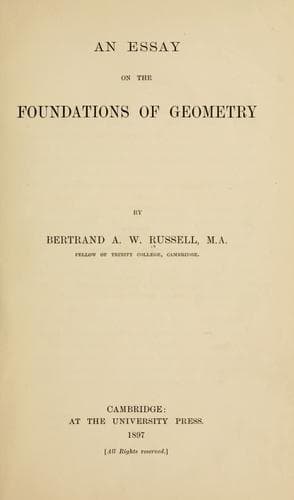
An essay on the foundations of geometryRussell, Bertrand
Philosophy
An essay on the foundations of geometry
Russell, Bertrand
Geometry -- Foundations
=86.= Lotze opens with a somewhat startling statement, which,
though philosophically worthy to be true, does not appear to be
historically borne out. Euclidean Geometry has been chiefly shaken,
he says, by the Kantian notion of the exclusive subjectivity of
space--if space is only our private form of intuition, to which
there exists no analogue in the objective world, then other beings
may have other spaces, without supposing any difference in the world
which they arrange in these spaces (p. 233). This certainly seems
a legitimate deduction from the subjectivity of space, which, so
far from establishing the universal validity of Euclid, establishes
his validity only after an empirical investigation of the nature of
space as intuited by Tom, Dick or Harry. But as a matter of fact,
those who have done most to further non-Euclidean Geometry--with the
exception of Riemann, who was a disciple of Herbart--have usually
inherited from Newton a naïve realism as regards absolute space.
I might instance the passage quoted from Bolyai in Chapter I., or
Clifford, who seems to have thought that we actually see the images
of things on the retina[101], or again Helmholtz's belief in the
dependence of Geometry on the behaviour of rigid bodies. This belief
led to the view that Geometry, like Physics, is an experimental
science, in which objective truth can be attained, it is true, but
only by empirical methods. However, Lotze's ground for uncertainty
about Euclid is a philosophically tenable ground, and it will be
instructive to observe the various possibilities which arise from it.
Public-domain text, read in full here on John Shaqi.
Reviews
Reviews
No reviews yet
Be the first to share your thoughts on this work.
Elsewhere in the archive
Join the Discussion
Join the discussion
Sign in to leave a comment or review.
Sign InorCreate an account