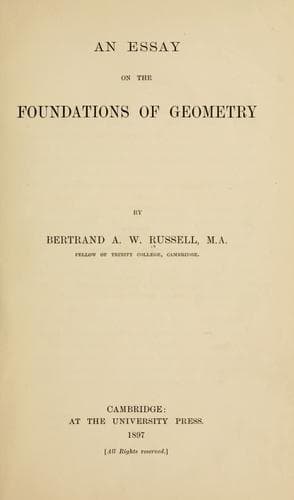
An essay on the foundations of geometryRussell, Bertrand
Philosophy
An essay on the foundations of geometry
Russell, Bertrand
Geometry -- Foundations
If space is only a subjective form--so Lotze opens his
argument--other beings may have a different form. If this corresponds
to a different world, the difference, he says, is uninteresting:
for our world alone is relevant to any metaphysical discussion. But
if this different space corresponds to the same world which we know
under the Euclidean form, then, in his opinion, we get a question of
genuine philosophic interest. And here he distinguishes two cases:
_either_ the relations between things, which are presented to these
hypothetical beings under the form of some different space, are
relations which do not appear to us, or at any rate do not appear
spatial; _or_ they are the same relations which appear to us as
figures in Euclidean space (p. 235). The first possibility would be
illustrated, he says, by beings to whom the tone or colour-manifolds
appeared extended; but we cannot, in his opinion, imagine a manifold,
such as is required for this case, to have its dimensions homogeneous
and comparable _inter se_, and therefore the contents of the various
presentations constituting such a manifold could not be combined
into a single content containing them all. But the possibility of
such a combination is of the essence of anything worth calling a
space: therefore the first of the above possibilities is unmotived
and uninteresting. Lotze's conclusion on this point, I think, is
undeniable, but I doubt whether his argument is very cogent. However,
as this possibility has no connection with that contemplated by
non-Euclideans, it is not worth while to discuss it further.
Public-domain text, read in full here on John Shaqi.
Reviews
Reviews
No reviews yet
Be the first to share your thoughts on this work.
Elsewhere in the archive
Join the Discussion
Join the discussion
Sign in to leave a comment or review.
Sign InorCreate an account