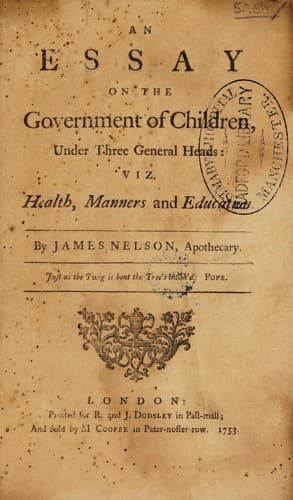
An essay on the government of children, under three general heads, viz. health, manners, and educationNelson, James
History
An essay on the government of children, under three general heads, viz. health, manners, and education
Nelson, James
Child rearing -- England -- History -- 18th century
boundless Grief. A generous Father who has spared no Cost to promote his
Son’s Felicity; a tender Mother, who with endless Anxiety has sought the
fairest Prospect for her favourite Boy; view them alternately struggling
with Love, and Rage, and Fear, and Resentment! What must they feel to
see their Expectations frustrated, their utmost Wishes vanished, their
darling Child undone! We say, it is dangerous to rouze a sleeping Lion;
nor is it less so, to kindle the Resentment of Parents: for to be greatly
exasperated is to fall into a Frenzy, which we cannot stop at Will. Thus
it often happens with those whose Children precipitate themselves into
Misery; their Rage becomes a continual Resentment, or an unconquerable
Hatred. And alas! how dreadful are the Effects! What more common than
for a Child to be banished from his Parents for a Step like this. I
know not what Effect a Description may have on those who hear or read
it, but, for my own Part, I think a Child, who thro’ such gross Folly
and Disobedience has shut himself out from the Doors, the Hearts, the
Affection of his Parents, is in the most calamitous Situation upon Earth.
But let us change the Scene. Let us suppose the Parents Grief subsided,
or that Love and Pity have got the better of Resentment. How fares it
with the disproportioned Couple? Does a Reconciliation with the Parents
secure Happiness to them? Alas, no; they know but little of Life who
conclude so. There is always Danger in Disparity, especially where Vanity
or Ambition predominates. The Woman who is suddenly lifted up from a very
low Condition, commonly makes but an aukward Figure; and what is worse,
she is apt, in affecting to be like her Betters, to misuse the Dominion
she is invested with; and, instead of demeaning herself like a good
Wife, she becomes a Vixen, a Shrew or a Tyrant. Yet granting that none
of these Evils happen, granting that a Woman has really Merit, and that
the labours to improve her natural Talents, in order to suit them to her
new Condition, there are still other Evils to fear. Reflection on past
Folly naturally draws Resentment on the Object of it: and tho’ when two
Parties once become Man and Wife, they are obliged to maintain Fidelity,
Tenderness and Love to one another; yet Experience unhappily shews us
that this Obligation is often violated. He who is extravagantly fond
without Regard to Merit, will often be unreasonable without Provocation.
Thus, when a Man, in his cooler Thoughts, compares what he is, with what
he might have been; reflects on what he has lost in grasping imaginary
Happiness, or views himself, thro’ a Disparity of Years, chained to faded
Beauty, to declining Life, while himself is in his Bloom; not all the
natural or acquired Merit of his Wife, not all the Tenderness that can
flow from the sincerest Love will be able to balance his Disappointment:
he frets, and swears, and raves, he breaks out into Extravagancies, which
Public-domain text, read in full here on John Shaqi.
Reviews
Reviews
No reviews yet
Be the first to share your thoughts on this work.
Elsewhere in the archive
Join the Discussion
Join the discussion
Sign in to leave a comment or review.
Sign InorCreate an account