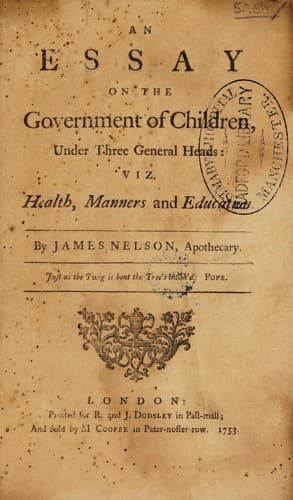
An essay on the government of children, under three general heads, viz. health, manners, and educationNelson, James
History
An essay on the government of children, under three general heads, viz. health, manners, and education
Nelson, James
Child rearing -- England -- History -- 18th century
Education, tho’ design’d to lead us to every Advantage, is often bestowed
to our Disadvantage, by being the Cause of many Errors, we should
otherwise have escaped. Education is often wasted on us, either by being
improper for our Station, or by engaging us in things we are unfit for.
Education is a Term that often misleads Parents themselves; for many do
not know either it’s Extent or Use, nor know if their Children possess
it or not. These things considered, it is easy to conclude how common an
erroneous Education must be; and how much it behoves Parents to reflect
on the necessary Means to obviate the like Errors for the future.
I remember a Lady whose Coachman was an Instance of the Mistakes I have
been speaking of. I am resolved, says he to some of his Acquaintance,
to have one Gentleman in my Family at least. In order thereto, he gave
his Son Education, and then put him to an Attorney: this entitled the
young Fellow to dress out, and keep, what he call’d, good Company;
these led him to Pleasures, Gallantry, and many other Extravagancies;
in fine, the old Man broke his Heart; and the young one in a short time
was utterly ruined. But how much happier would he probably have been,
had he kept to his proper Sphere, and been a Coachman too! It frequently
happens, that honest industrious Men among the common Trades, as well
as others, grow wealthy, and consequently are ambitious of giving their
Children Learning; now as these People have usually but a very small
Share themselves, they know little more of it than the Name: they send
a Boy to School, and because they hear him speak hard Words, and see him
hammering at a Latin Exercise, sagely conclude that he has Learning; when
it is fifty to one, that, comparatively speaking, he knows nothing. It
requires a great deal of Time, Diligence, and Application for a Boy to
become a good Grammarian, tho’ taught by the best Methods and the best
Masters; what then must be the Fate of those who are under bad Teachers?
and that there are some such, I believe will not be disputed. But
supposing a Boy really acquires some Knowledge; let us see of what Use
it will be to him: his Father is perhaps a Baker, and it is convenient
to him to bring his Son up to his own Business; what does a Baker want
with Latin? nothing. Besides, continued Disuse will make him forget it;
or, should he retain it, of what Use could it be to him, but to make him
pedantic and self-conceited? But perhaps upon the Presumption that this
Boy is a Scholar, the honest Baker, desirous that his Son should cut a
Figure, sends him to the University, and he becomes a Divine: but what
Pity is it that a good Baker should be spoiled? The innocent young Man,
tho’ spirited up by his fond mistaken Parents, has perhaps no Talents,
no Genius, no Interest; what then must be his Fate? why—he must drudge,
and court, and wait his whole Life, and at last gain nothing. What can
be more mistaken than this Conduct, and yet what more common? It may be
Public-domain text, read in full here on John Shaqi.
Reviews
Reviews
No reviews yet
Be the first to share your thoughts on this work.
Elsewhere in the archive
Join the Discussion
Join the discussion
Sign in to leave a comment or review.
Sign InorCreate an account