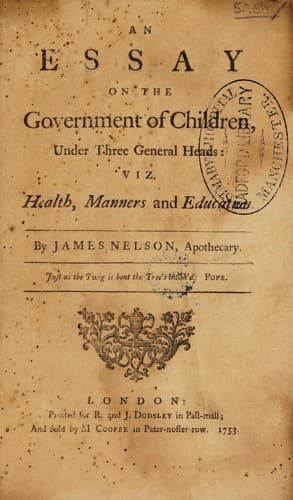
An essay on the government of children, under three general heads, viz. health, manners, and educationNelson, James
History
An essay on the government of children, under three general heads, viz. health, manners, and education
Nelson, James
Child rearing -- England -- History -- 18th century
Human Nature (as daily Experience shews us) is, in the general, alike in
all, from the Prince to the Peasant: the same Weaknesses attend us; the
same Passions torment us; the same Diseases kill us: all are the Work
of ONE GREAT ARTIST! all are born for the same great End! The Gifts of
Fortune indeed are innumerably different; the Advantages of Education
very many; and as a Train of Vices corrupts our Manners, so a Succession
of Virtues may be said to enoble our Birth and purify our Blood. Hence it
is we often see those exalted Virtues in the Great and Noble inherited
by their Posterity; and hence too we often discover, even where Pains
are taken to conceal it, an inbred Dignity, a Mein and Aspect superior
to the Generality of Men. Still this Rule is by no Means universal; for
the same Experience shews us, that great Men can do little things; even
such as the private and obscure would be ashamed of. And how so? because
Passion, not Reason, is their Guide. Parents then, we see, even of the
highest Rank, are under an indispensable Obligation of regulating the
Manners of their Children. Philosophers say, that all Passions are in all
Men; but that their Predominance is unequal, and different in different
Men: if so, the Great stand in most need of having them subdued, or at
least regulated, as the Power to indulge them is greater in them than
in others. But granting that Parents of Quality are convinced of these
Truths, and take all the Steps already recommended for training up their
Children in proper Decorum; granting too, that they design every thing
for their real Advantage; they have still many things both to do and
avoid which are not common to all.
Their first Care must be to avoid Sycophants, Flatterers, and Hypocrites;
they are but too constant Attendants on the Great, and their Business is
to diffuse an imperceptible Poison (if I may be allowed the Metaphor)
over both Parents and Children. Nothing is so amiable as Truth, nothing
more desirable, and yet nothing more difficult to reach the Great. If
a Nobleman has a Child whose Parts are weak, whose Genius is slow and
shallow, it is undoubtedly a Misfortune, but cannot be his Fault: the
natural Blindness of Parents keeps them from seeing these Defects so
clearly as another; but the unnatural, at least unmanly Artifices of the
Flatterer totally prevent their seeing them at all: and thus the noble
Heir is mistakenly taught to think himself what Nature has forbid he
shall ever be.
Public-domain text, read in full here on John Shaqi.
Reviews
Reviews
No reviews yet
Be the first to share your thoughts on this work.
Elsewhere in the archive
Join the Discussion
Join the discussion
Sign in to leave a comment or review.
Sign InorCreate an account