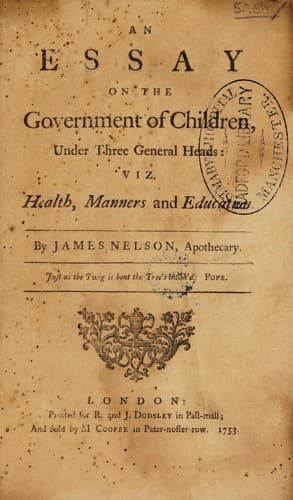
An essay on the government of children, under three general heads, viz. health, manners, and educationNelson, James
History
An essay on the government of children, under three general heads, viz. health, manners, and education
Nelson, James
Child rearing -- England -- History -- 18th century
Another Care is, that Youth of Quality, who have Parts and Quickness, be
not suffered to waste the first Flower of their Age in Idleness: it is a
grievous Error, yet very common. I have already observed, that Parents
who know nothing are injudiciously, and even anxiously solicitous to
have their Children Scholars; and by a strange reverse Infatuation,
Parents of Rank are often very indifferent about it. This Error is
undoubtedly sometimes owing to themselves only by a supine Negligence
in their own natural Temper; but it is much oftener owing to the false
Praises given by those that have both the Parents and the Child’s Ear.
A young Heir soon knows the Title, Dignity and Estate he is born to
possess; too soon does he know his Independence, and too apt is he to
grow careless about his Learning on this very Account, but if to these
Impediments be added imaginary Excellence and Knowledge, thro’ the daily
Flattery of a Dependent, what is likely to be the Consequence? why, that
he will remain ignorant his whole Life. For who will take Pains to learn,
that is firmly persuaded he knows enough already? and that many of our
young Noblemen are trained up in this Disposition, nobody, I believe,
will deny: it is true that Time may convince them of their Error; but it
will then perhaps be too late to recover what they have lost.
The Education of a Nobleman should contain every thing that is both
useful and ornamental. As he is more conspicuous than others, as he
always stands on an Eminence, his Education should be such as may reflect
a Lustre on every one that beholds him. He is to be considered as a
Pillar of the Laws, an Honour and an Ornament to the Age he lives in. To
this End he is to study first, Languages; that is to say, two of the dead
ones, _viz._ _Latin_ and _Greek_; and of the living ones, besides his
Mother-tongue, _French_ at least. The Learned disagree very much as to
the Variety of Languages necessary to be acquired; some are of Opinion,
that besides these already named, _Italian_, _Spanish_, _Portuguese_,
and more yet, are becoming the Education of a great Man; and urge in
their Favour, that the more Languages are gained, the more the Mind is
enlarged: others dissent from this, and maintain, that a great Variety
rather confuses the Mind than otherwise; that _Latin_ and _Greek_ are
indisputably the Languages of all learned Men; after those, _French_,
and at most _Italian_, are all that need be added, as every thing may
be found in these, either originally or translated into them: but they
farther argue, that it is a great Waste of Time, spent merely in the
Acquisition of Languages, when so many nobler Studies are to be pursued;
Studies which at once strike the Mind, and constitute true Science. This
last Reasoning has, I think, great Force; but here for a Moment let me
leave the Nobleman, to make an Observation on general Life. Languages,
besides being considered as general Parts of Education, are particularly
Public-domain text, read in full here on John Shaqi.
Reviews
Reviews
No reviews yet
Be the first to share your thoughts on this work.
Elsewhere in the archive
Join the Discussion
Join the discussion
Sign in to leave a comment or review.
Sign InorCreate an account