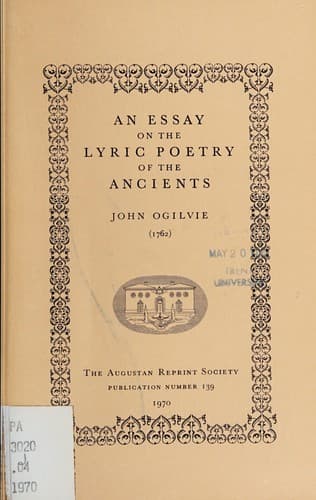
An Essay on the Lyric Poetry of the Ancients — John Shaqi
An Essay on the Lyric Poetry of the AncientsOgilvie, John
History
An Essay on the Lyric Poetry of the Ancients
Ogilvie, John
Classical poetry -- History and criticism
It is an observation, no doubt, familiar to your Lordship, that Genius
is the offspring of Reason and Imagination properly moderated, and
co-operating with united influence to promote the discovery, or the
illustration of truth. Though it is certain that a separate province is
assigned to each of these faculties, yet it often becomes a matter of
the greatest difficulty to prevent them from making mutual
encroachments, and from leading to extremes which are the more
dangerous, because they are brought on by an imperceptible progression.
--Reason in every mind is an uniform power, and its appearance is
regular, and invariably permanent. When this Faculty therefore
predominates in the sphere of composition, sentiments will follow each
other in connected succession, the arguments employed to prove any point
will be just and forcible; the stability of a work will be principally
considered, and little regard will be payed to its exterior ornament.
Such a work however, though it may be valued by a few for its intrinsic
excellence, yet can never be productive of general improvement, as
attention can only be fixed by entertainment, and entertainment is
incompatible with unvaried uniformity[1].
[Footnote 1: Neque ipsa Ratio (says the elegant and sensible
Quintilian speaking of Eloquence) tam nos juvaret, nisi quæ
concepissemus mente, promere etiam loquendo possemus,--ita, ut non
modo orare, sed quod Pericli contigit fulgerare, ac tonare
videamur. Institut. Orat. Lib. XI. c. 16.]
On the contrary, when Imagination is permitted to bestow the graces of
ornament indiscriminately, we either find in the general that sentiments
are superficial, and thinly scattered through a work, or we are obliged
to search for them beneath a load of superfluous colouring. Such, my
Lord, is the appearance of the superior Faculties of the mind when they
are disunited from each other, or when either of them seems to be
remarkably predominant.
Public-domain text, read in full here on John Shaqi.
Reviews
Reviews
No reviews yet
Be the first to share your thoughts on this work.
Join the Discussion
Join the discussion
Sign in to leave a comment or review.
Sign InorCreate an account